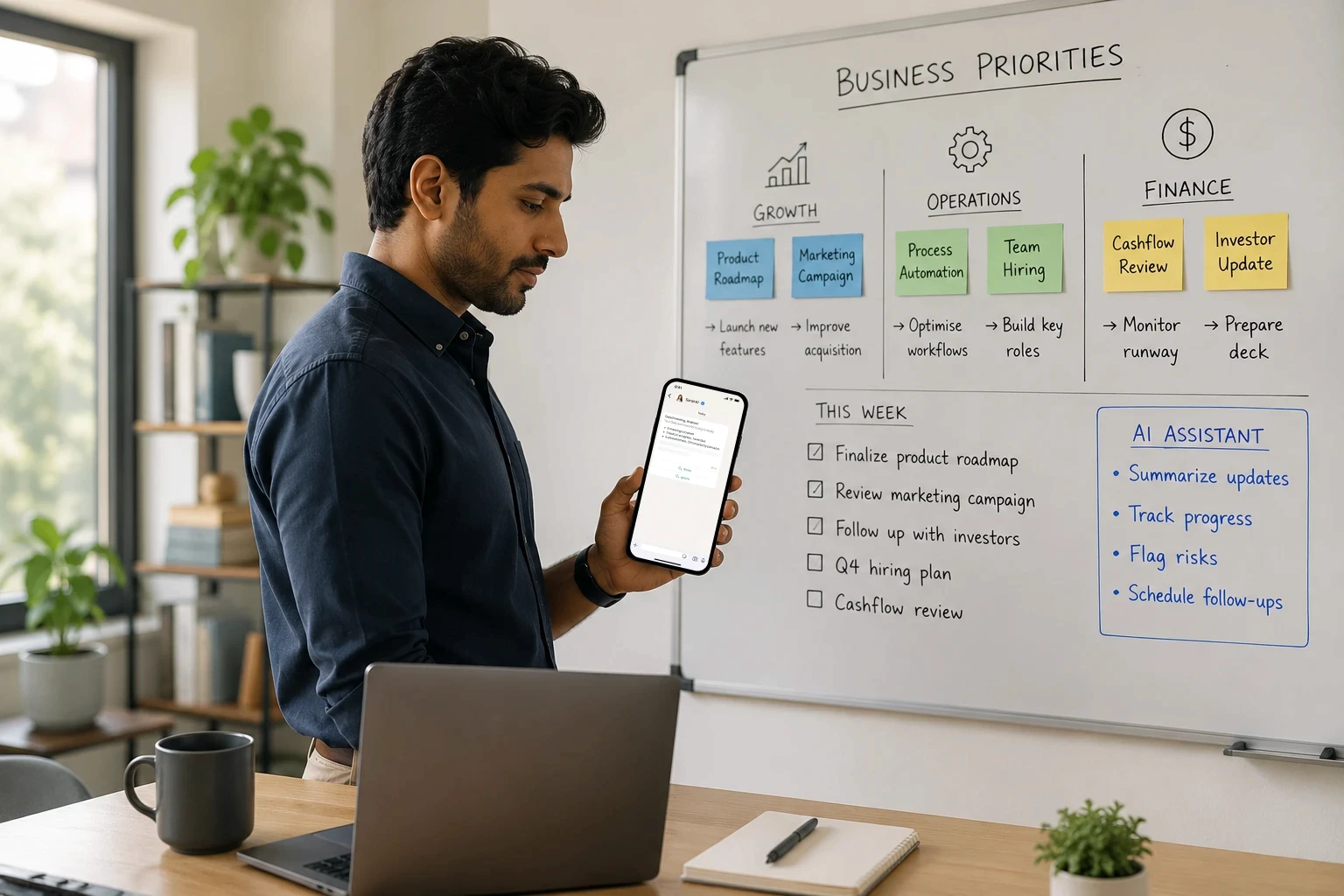
WhatsApp-Based AI Assistant vs a Dedicated AI Assistant App: Which Actually Works for Your Business?
AI Strategy
7 Min
|

Copied


Quick Summary
The average business owner typically has 12 apps on their phone that they operate with great intention, use for two weeks, and now scroll past without guilt.
That number is not a joke. It is a pattern.
Every quarter, a new productivity tool promises to fix your workflow. You download it, go through onboarding, build the habit, and then slowly drift back to the one app that is always open by default: WhatsApp.
This is not a failure of willpower. It is a signal worth paying attention to.
The debate around WhatsApp-based AI assistant vs a dedicated AI assistant app is not really a feature comparison. It is a question about human behaviour. About where people actually show up, and what kind of tool survives the gap between good intentions and one’s daily reality.
This post breaks it down without the fluff.
The Real Problem: App Fatigue Is Killing Productivity
Before comparing tools, it helps to name the actual enemy.
App fatigue is what happens when the number of tools a founder manages starts generating more cognitive load than the problems those tools were supposed to solve. Each app carries its own login, its own interface logic, its own notification cadence, its own learning curve.
The research is consistent. Context switching between applications costs the average knowledge worker more than two hours of deep focus per day. For an SME founder already wearing five hats, that is not a productivity leak. It’s a flood.
The irony is that most AI tools designed to save time are themselves becoming another tab to manage.
A dedicated AI assistant app, however powerful, still asks one fundamental thing of you: come to me. Log in. Stay inside this interface. Build your life around my UX.
WhatsApp does the opposite. It does not ask you to come to it. You are already there.

What 'WhatsApp-based AI ' Actually Means in 2026
Let us be precise, because this term gets used loosely.
A WhatsApp-based AI business tool, in its truest form, is an AI assistant that operates natively within WhatsApp. Not a chatbot that sends automated messages. Not a notification relay that pings you when something changes in another system.
A genuine WhatsApp-based AI integration means:
You send a voice note or text, and the AI understands the intent
It creates tasks, sets reminders, schedules meetings, or delegates work
It confirms the action back to you in the same thread
It follows up, tracks progress, and surfaces what matters
This is business messaging AI that operates inside the most-used communication channel on the planet. Over two billion people use WhatsApp. In the GCC, South Asia, and Southeast Asia, it is not just common. It is the default operating layer of business communication.
We explored this shift in depth in How WhatsApp Became the Operating System of SMEs. The short version: for most founders outside North America and Western Europe, WhatsApp is already where decisions get made, clients are managed, and teams stay coordinated. AI that lives there does not disrupt that flow. It amplifies it.
What a Dedicated AI Assistant App Does Well
A dedicated AI assistant application is purpose-built. Its interface is designed entirely around the AI interaction. There are no unread messages from your supplier. No group chats. No distractions.
The Case for a Standalone Interface
For certain use cases, a dedicated environment genuinely helps. When you need to review a week of tasks, restructure your calendar, or look at cross-team workload at a glance, a structured dashboard delivers clarity that a chat thread cannot.
Dedicated apps also tend to offer:
Richer visualisation. Task boards, calendar views, and progress tracking are easier to render in a full app environment than inside a messaging interface.
Deeper integrations. Connecting to CRMs, project management tools, and email pipelines is typically more robust in a standalone app with a structured API layer.
Offline functionality. Many dedicated apps cache data and allow interaction without a live connection, useful in regions with patchy mobile coverage.
Admin controls for teams. Role-based access, audit logs, and team-level reporting tend to be better supported in dedicated environments.
These are real advantages. They matter most to teams above a certain size, or to operations with complex multi-tool workflows.
What a Dedicated AI Assistant App Gets Wrong
Here is the part most AI app companies will not say out loud.
The most sophisticated AI tool in the world is useless if your team does not open it every day. Adoption is the real benchmark. Not features.
The Onboarding Drop-off Problem
Every new app experiences the same curve. High intent at download, active use in week one, gradual decline by week three, dormancy by week six. This is not a niche problem. Product teams across the SaaS industry track it obsessively because it is so consistent.
For SME founders, the drop-off is even steeper. There is no IT department enforcing tool adoption. There is no onboarding manager following up. The founder uses it when they remember, which gets less frequent as urgency pulls them back to WhatsApp.
The Notification Problem
A dedicated app sends you a notification to check it. You are now managing a tool that manages your tasks by asking you to go back to the tool. This loop is more exhausting than it sounds.
WhatsApp-based AI assistant removes this loop entirely. The update arrives where you already are. The action happens in the same thread where you are already paying attention.
The Team Adoption Problem
Getting yourself to use a new app is hard. Getting your entire team to use it consistently, without the culture of accountability that enterprise companies build around their tools, is much harder.
When AI assistance is delivered over WhatsApp, every team member is already present. There is no onboarding barrier. No new login. No training session. The tool works inside the channel your team already uses to communicate.
Side-by-Side: WhatsApp-based AI Assistant vs Dedicated AI Assistant App
What Matters to Founders | WhatsApp-based AI Assistant | Dedicated AI Assistant App |
|---|---|---|
Adoption friction | Very low - no new behaviour required | High - requires habit change |
Team onboarding | Instant - everyone has WhatsApp | Requires training and enforcement |
Voice input | Natural - send a voice note | Depends on app; often limited |
Access on the go | Always open, mobile-native | Requires app switch |
Dashboard and visualisation | Limited in chat view | Strong advantage |
Deep integrations | Growing; depends on the tool | Typically stronger |
Notification fatigue | None - same thread | Adds another alert channel |
Works in low-data environments | Yes | Varies |
Best for | Founders and field operators | Office-based teams with complex workflows |
The honest read: neither wins cleanly. They solve different parts of the same problem. The question is which part of the problem is costing you the most right now.
The Mobile-First AI Reality
Mobile-first AI is not a trend. It is the operating reality for most SME founders in 2026.
Research from GSMA shows that over 60% of internet usage in the Middle East, Africa, and Southeast Asia happens entirely on mobile devices. Many of these users may not have a primary work computer. Their business runs from a phone.
For this audience, the debate is already settled. A desktop-optimised AI platform with a mobile companion app is not mobile-first. It is mobile-adjacent. There is a difference that shows up in the daily experience.
AI chat integration that runs natively within WhatsApp meets founders where they are. On the road. Between site visits. At the airport boarding area. In the back of a car. At 10 pm, when the thought arrives, and there is no laptop nearby, or it can be easily accessed.
We wrote about exactly this moment in Turn Voice Notes into Tasks: A Guide for Busy Entrepreneurs. The window between having a thought and losing it is seconds long. The best AI tool is the one that catches it in that window, not the one waiting in another app.
Why the Best Answer Is Not Either/Or
Here is what the comparison debate misses.
The assumption behind WhatsApp-based AI assistant vs a dedicated AI assistant app is that you must choose one. In practice, the founders who get the most from AI assistance tend to use both in different contexts, and the smartest AI tools are built for exactly that.
A WhatsApp-based AI business tool handles the fast-moving, in-the-moment, on-the-go layer. Capture a task. Set a reminder. Delegate to a team member. Get your daily briefing.
A dedicated app handles the strategic, review-oriented, dashboard layer. See everything at once. Restructure workflows. Analyse what is overdue.
These are complementary modes, not competing products. The problem with most tools is that they force you to pick. They are built for one context and awkward in the other.
Voice-First Leadership: Capturing the Speed of Thought on the Move makes a connected argument: the most valuable productivity gains come not from better dashboards, but from capturing decisions at the speed they actually happen. That requires a mobile-first, voice-ready, always-available layer.
Where SarahAI Sits in This Debate
SarahAI is the only AI executive assistant that gives you both.
The WhatsApp interface handles everything that needs to happen in motion. Send a voice note, get a task created. Text a reminder, it gets logged and followed up. Ask for your daily brief; it arrives in the thread you check every morning anyway.
The SarahAI app handles the structured view. See your task board. Review your team's workload. Check what is overdue. Manage calendar events with full context.
This is not a workaround. It is intentional architecture. The founders we work with do not want to choose between convenience and clarity. They want an AI business tool that meets them in both places.
The practical result: adoption does not drop off after week three, because there is no new habit to build. SarahAI works inside WhatsApp, which is already open. And when you want the broader view, the app is there.
This is what Why Small Businesses Deserve Big AI argues at its core. SMEs should not have to accept a worse product because they cannot afford a 20-person IT implementation. They deserve tools that work the way they work.
Pain Points This Comparison Solves
My team never actually uses the tools I roll out
This is the most common frustration we hear from founders. The root cause is almost always adoption friction. When AI assistance is delivered over WhatsApp, your team is already present. There is no new tool to adopt. The assistant joins the channel that already exists.
I forget to check the app unless something breaks
A dedicated app that you visit reactively is not an AI assistant. It is a database. The value of a true WhatsApp-based AI integration is that it reaches you proactively. Your daily brief arrives in the morning. Overdue task alerts surface in the thread. You do not have to remember to check.
I need to use it mid-meeting, between calls, on the road
This is where dedicated apps struggle most. The moment you are in a physical environment, juggling attention across conversations and decisions, a screen-heavy app creates friction. A voice note into WhatsApp, processed by AI and turned into an action in under five seconds, does not.
I tried three AI tools this year, and none of them stuck
This is the app fatigue reality described at the top of this post. The pattern breaks when the tool does not require a new context. AI embedded in a platform you already live in does not compete for attention. It extends the value of the attention you are already spending.
Frequently Asked Questions
Is WhatsApp-based AI safe for business use?
WhatsApp Business API, which powers AI integrations like SarahAI, uses end-to-end encryption. Business data shared through AI commands, such as task creation and reminders, is handled under the same security standards as standard WhatsApp messaging. For enterprise-level compliance requirements, dedicated apps with SOC 2 certification may be more appropriate.
Can a WhatsApp-based AI assistant handle team task delegation?
Yes. SarahAI allows founders to assign tasks to team members directly from WhatsApp. The assignee receives a notification in their own WhatsApp thread, and progress can be tracked without anyone needing a separate application.
What is the difference between a WhatsApp chatbot and a WhatsApp-based AI assistant?
A chatbot responds to specific commands within a fixed script. A WhatsApp-based AI assistant understands natural language, whether text or voice, interprets intent, takes action, and follows up. Chatbots answer. AI assistants act.
Do I need WhatsApp Business to use a WhatsApp-based AI tool?
It depends on the implementation. SarahAI works with both standard WhatsApp and WhatsApp Business accounts, making it accessible to founders without a formal business profile set up.
Will a dedicated AI assistant app integrate with WhatsApp?
Some do, partially - most offer notification delivery via WhatsApp, but not full two-way interaction. True WhatsApp-based AI integration, where you can create, update, and manage tasks entirely within a WhatsApp thread, is still rare.
The Bottom Line
The WhatsApp-based AI assistant vs dedicated AI assistant app question comes down to one thing: where do you actually show up every day?
If the answer is WhatsApp, which for most founders in 2026 is, then the most powerful AI tool, SarahAI, is the one that works there. Not alongside it. Not by sending you a notification to go somewhere else. Actually, inside it.
Dedicated apps have real strengths, particularly for structured review and complex team workflows. They are not going away. But for the in-motion, fast-decision, on-the-road layer of running a business, a WhatsApp-based AI business tool wins on the metric that matters most: you will actually use it.
As we argued in Beyond Automation: Why AI Assistants Are About Decisions, Not Just Tasks and Voice Is the Next Frontier: Why Talking to Your Assistant Beats Typing, the real productivity breakthrough comes from removing the distance between a decision and the action that follows it.
SarahAI removes that distance entirely.
It works in WhatsApp because you live in WhatsApp. And for the moments when you want the full picture, the app is there too.
That is not a compromise. That is a better product.