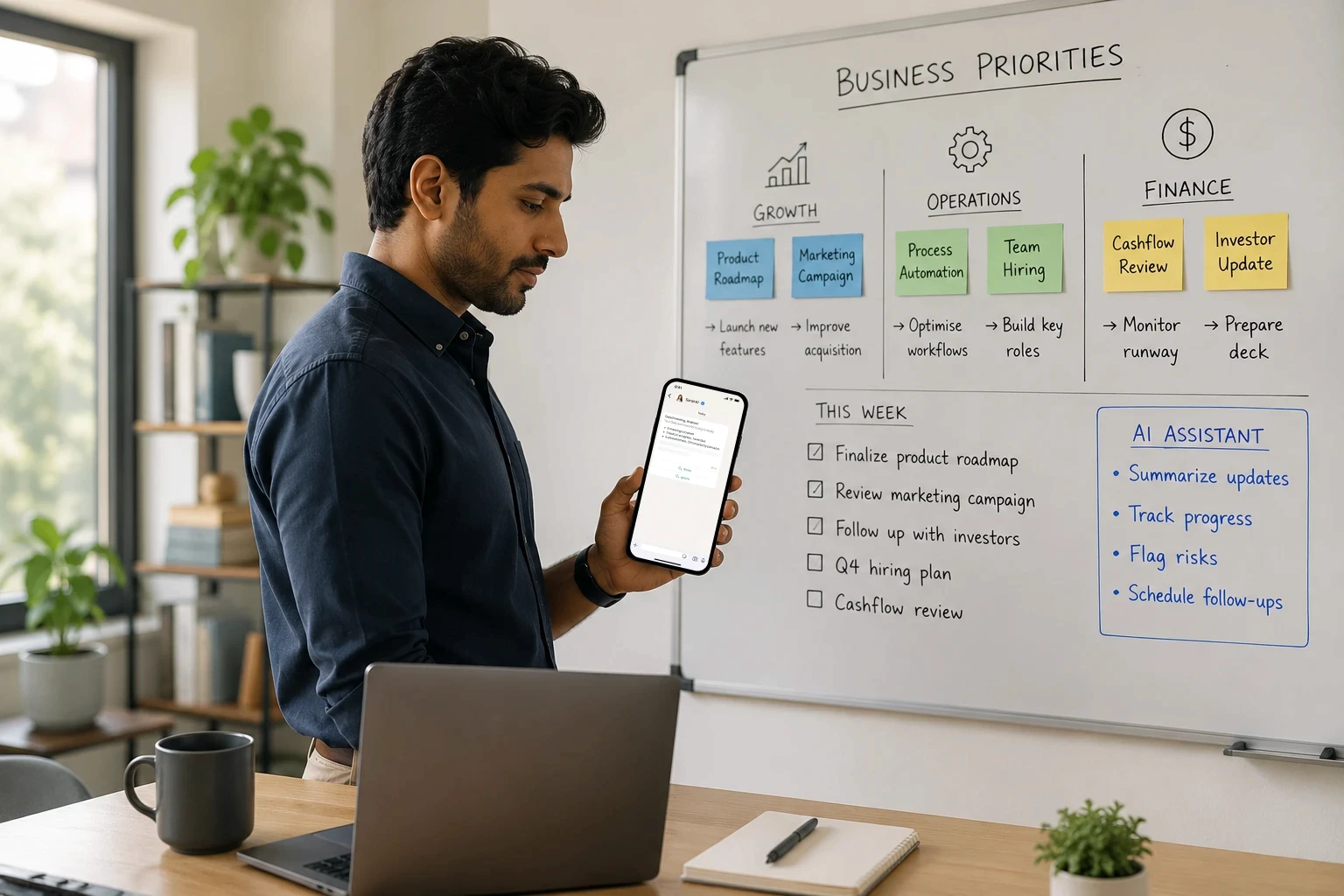
What Is an AI Chief of Staff? A 2026 Guide for SME Founders
AI Strategy
11 Min
|

Copied


Quick Summary
The Term Arrived Before the Definition
"AI chief of staff" started appearing on software pricing pages in 2025 and has spread quickly since. It is now attached to products that do very different things: calendar optimisers, agent platforms, meeting notetakers, and multi-function automation suites.
That vagueness is a problem for anyone trying to buy one. If two products carry the same label and one schedules meetings while the other reconciles invoices, the label has stopped carrying information.
The way out is to go back to what the human role actually does, then ask which parts of it a piece of software can credibly take on today. That is what this guide does - including an honest account of what the category still cannot do, and why most SMEs are better served by something simpler.

What a Human Chief of Staff Actually Does
Before evaluating any software, it helps to be precise about the role it claims to replicate. In practice, a chief of staff does four things.
Notice what is not on that list: booking meetings, taking notes, managing an inbox and chasing personal to-dos. Those belong to an executive assistant. The two roles are frequently conflated in software marketing, and the distinction matters when deciding what to buy.
AI Chief of Staff vs AI Executive Assistant
This is the distinction that decides most purchases, and it is worth being blunt about it.
AI Executive Assistant | AI Chief of Staff | |
|---|---|---|
Scope | Your day | The business around your day |
Core question it answers | "What do I need to do and when?" | "What is happening across the company and what is stuck?" |
Typical capabilities | Meetings, tasks, reminders, delegation, inbox summaries, daily briefs | Cross-functional visibility, decision tracking, function-level reporting, cadence management |
Data it needs | Your calendar, your email, your task list | Systems across sales, finance, operations and HR |
Who it replaces work for | The founder personally | The founder plus the leadership layer |
Right for | Solo operators and SMEs up to roughly 20 people | SMEs with distinct functions and a leadership team |
Set-up burden | Low - connect calendar and email | High - depends on connected systems across the business |
Typical price point | Around $10–$30 per user per month | Materially higher, often demo-led rather than self-serve |
The practical implication: a tool that only sees your calendar and inbox cannot do chief-of-staff work, regardless of what it is called, because it has no visibility into the functions it would need to coordinate. When a product carries the label, the first question to ask is what it is connected to.
What an AI Chief of Staff Can Credibly Do in 2026
Taking the four human jobs in turn, here is an honest assessment of where software has reached.
Cadence management - mostly solved
Scheduling recurring reviews, ensuring inputs are collected beforehand, distributing outputs afterwards. This is well within reach of current tools, and is the least interesting part of the role.
Decision tracking - partially solved
Software can now record what was decided, assign owners and deadlines, and surface items that have gone past due. What it cannot reliably do is judge whether an action taken actually satisfies the decision, or notice that a decision has quietly been abandoned because circumstances changed. That still needs a person.
Cross-functional visibility - depends entirely on integration
A tool connected to your CRM, accounting system and project tracker can genuinely compress the state of the business into a readable summary. A tool connected to nothing but your calendar cannot, no matter how capable the underlying model is. This is where most of the gap between marketing and reality sits.
Anticipation - largely unsolved
The part of the role that makes a good chief of staff valuable - knowing which disagreement will surface tomorrow, which investor question is really about something else, when to interrupt the founder and when not to - depends on organisational and interpersonal context that no current product has access to. Vendors that imply otherwise are overselling.
4 jobscadence, decision chasing, visibility and anticipation - the real role, in order of automatability | 2 of 4are substantially automatable today; visibility depends on integration, anticipation does not | ~20the team size below which an executive assistant usually beats a chief of staff |
Assessment based on the capability boundaries of current products in the category, not a published study. Test any vendor’s claims against the four jobs above.
How to Evaluate a Product Claiming the Label
Five questions that separate substance from positioning.
What is it connected to? Cross-functional coordination requires cross-functional data. If it only reads your calendar and inbox, it is an assistant with a bigger name.
Does it act, or only report? A dashboard summarising four systems is useful, but it is business intelligence. A chief of staff chases the thing that is stuck.
What happens when something is not done? The valuable behaviour is surfacing the gap unprompted. Ask to see that specific flow in a demo rather than the happy path.
What is the setup burden, honestly? Products in this category are only as good as the systems they are wired into. Ask how long a comparable customer took to reach useful output.
Is the pricing self-serve or demo-led? Demo-led usually signals genuine implementation work. That is not a criticism, but it changes the buying decision from a subscription into a project.
Where SarahAI Fits - Stated Plainly
01 SarahAIAI assistant on WhatsApp, with chief-of-staff tiers in early access |
What the live product does SarahAI’s available product is an AI Assistant. It runs inside WhatsApp with iOS and Android apps for configuration and in-app voice control. It creates and tracks tasks, delegates work to others, schedules and reschedules meetings, and sets reminders delivered on WhatsApp - by typing or by voice note, in over 100 languages. It summarises unread email with priority alerts and sends intelligent daily morning briefs and weekly summaries covering meetings, pending and overdue tasks and priority emails. Newly announced integrations extend to Notion, Slack and Zoho CRM. |
Which of the four jobs it covers Cadence, at the personal level: your meetings happen, your reminders fire, your overdue items surface in the morning brief. It does not do cross-functional decision chasing or function-level reporting, because it is connected to your calendar and inbox rather than to your finance and sales systems. |
The chief-of-staff tiers AI Growth Pro adds CRM workflows - Zoho, HubSpot and Pipedrive - with a sales automation agent, smart deal nudges, weekly pipeline reports and outbound calling for follow-ups. AI Chief of Staff adds functional agents across finance and accounting, HR and operations, and project management with Asana, Trello, Monday.com and ClickUp. Both are currently in early access and available via demo rather than self-serve signup. |
Pricing (2026) AI Executive Assistant: $9.99/user/month, annual billing saves 17%. Includes unlimited tasks, events and reminders, daily and weekly briefs, email summaries and priority alerts, 2 calendar and 2 email integrations, 100 minutes of voice conversation and 100 business or general questions per month. 14-day free trial, no credit card required. Growth Pro and Chief of Staff tiers are demo-led. |
What it does not do SarahAI does not draft or send emails, does not join calls or take meeting notes, and does not auto-schedule your task list into calendar slots. Its email capability is summarising unread messages and flagging priority senders. If you need any of those, it is worth knowing before you trial it. |
Which One Does Your Business Actually Need?
Solo founder or under 10 people
An executive assistant, without question. There are no functions to coordinate yet - there is you, doing most of them. The binding constraint is your own capacity, and the highest-return fix is making sure commitments made in conversation reach a calendar, a reminder or a colleague.
10–25 people, functions starting to separate
Still assistant-first, but this is where the second problem appears: you no longer see everything, and things get agreed in a function without reaching you. Start with an assistant that handles delegation and follow-up tracking, and add CRM or project integrations as the specific blind spots become clear rather than buying a coordination suite upfront.
25–100 people with a leadership team
This is where chief-of-staff capability starts genuinely earning its cost. There are distinct functions, decisions that cross them, and a real risk of things stalling between owners. Evaluate on integration depth and on what happens when something is not done - not on the breadth of the feature list.
Any size, but heavily process-driven
Some smaller businesses - clinics, agencies with strict delivery workflows, multi-site retail - have coordination complexity out of proportion to headcount. Judge by how many systems hold information you need to reconcile weekly, not by employee count.
What the Category Still Cannot Do
Start With the Constraint, Not the Title
The term "AI chief of staff" is doing a lot of work in software marketing right now, and it is worth resisting the pull of the title when deciding what to buy.
Ask what actually breaks in a bad week. If the answer is that you forgot three things, missed a follow-up and arrived at a meeting unprepared, that is an executive assistant problem and it is solvable cheaply today.
If the answer is that a decision made three weeks ago never reached operations, that finance and sales are working from different numbers, and that you only find out when something has already gone wrong - that is coordination, and it needs a tool wired into those systems, plus a person exercising judgement over the output.
Most SMEs asking about AI chiefs of staff have the first problem. Solving it well is usually worth more than buying for the second one prematurely.
More from SarahAI
Frequently Asked Questions
What is an AI chief of staff?
An AI chief of staff is software that takes on the coordination work a human chief of staff does: running the operating cadence, tracking decisions across functions, giving the founder visibility without attending every meeting, and preparing them for what is coming. In practice the term is used loosely across very different products, so the useful test is which of those four jobs a given tool actually performs and what systems it is connected to.
What is the difference between an AI chief of staff and an AI executive assistant?
An AI executive assistant manages your day - meetings, tasks, reminders, delegation, inbox summaries and daily briefs. An AI chief of staff manages the business around your day - cross-functional visibility, decision tracking and function-level reporting. The assistant needs your calendar and email. The chief of staff needs connections into sales, finance, operations and project systems, which is why it costs more and takes longer to implement.
Does an SME need an AI chief of staff?
Usually not at first. Chief-of-staff coordination assumes there are separate functions to coordinate, which typically means a leadership team and roughly 25 or more people. Below that, the binding constraint is normally the founder’s own capacity, and an AI executive assistant addresses that at a fraction of the cost and setup effort.
Can an AI chief of staff replace a human chief of staff?
No, and vendors implying otherwise are overselling. Software can handle cadence management well and decision tracking partially. Cross-functional visibility depends entirely on which systems it is connected to. Anticipation - knowing which disagreement is about to surface, when to interrupt the founder, that a quiet team member is about to resign - relies on organisational context that no current product has access to.
How much does an AI chief of staff cost?
Pricing varies widely because the label covers very different products. AI assistant tools typically sit around $10 to $30 per user per month with self-serve signup. Products offering genuine cross-functional coordination are usually demo-led rather than self-serve, which generally reflects real implementation work rather than a pricing tactic.
Is SarahAI an AI chief of staff?
SarahAI’s live, self-serve product is an AI Executive Assistant at $9.99 per user per month, covering meetings, tasks, reminders, delegation, email summaries and daily briefs on WhatsApp. AI Growth Pro, which adds CRM workflows with Zoho, HubSpot and Pipedrive plus sales automation, and AI Chief of Staff, which adds finance, HR, operations and project management agents, are separate tiers currently in early access and available via demo.
What should I look for when evaluating an AI chief of staff tool?
Five things: what systems it is connected to, whether it acts or only reports, what it does when something has not been done, how much setup is genuinely required before it produces useful output, and whether pricing is self-serve or demo-led. Ask to see the exception flow in a demo - what happens when a decision stalls - rather than the happy path.