AI for D2C and E-commerce Founders in India
Country Spotlight
12 Min
|

Copied


Quick Summary
The Indian D2C Market Is Not the Same Problem as Global E-commerce
Most AI-for-e-commerce advice is written for Western markets where card payment is standard, return rates are modest and logistics are consolidated. Applying it directly in India produces a stack that optimises the wrong things.
The headline opportunity is real. India’s D2C e-commerce market was valued at around $87.5 billion in 2025 and reached approximately $108.76 billion in 2026, with projections of 24.3% compound growth to $322.1 billion by 2031. Smartphone adoption in tier-2 and tier-3 cities, the nationwide ONDC rollout and GST-enabled logistics efficiencies are all pulling in the same direction.
Source: Mordor Intelligence - India D2C E-commerce Market Analysis
The structural difficulty is equally real and much less discussed. Cash-on-delivery return rates running at 25–30% create sustained working-capital stress - stress significant enough that it has catalysed an entire revenue-based financing category extending 15–30% of monthly sales as short-term liquidity to brands trying to scale through it.
That single statistic should reorder most Indian D2C founders’ AI priorities. A brand shipping ten orders where three come back has an economics problem that no amount of conversion optimisation solves. This guide is ordered accordingly.
$108.76BIndia D2C e-commerce market size in 2026, growing at 24.3% CAGR (Mordor Intelligence) | 25–30%cash-on-delivery return rates driving working-capital stress across the sector | 20.55%of the market held by Delhi NCR in 2025; Hyderabad is the fastest-growing city node |
Source: Mordor Intelligence - India D2C E-commerce Market Analysis, 2026

How to Use This Guide
Five workflows, ordered by financial impact for an Indian D2C brand rather than by how interesting the technology is. Work down the list; do not start in the middle because the tools there are better marketed.
Workflow 1 - RTO and COD risk: reducing the returns that are eating your margin before anything else
Workflow 2 - Customer support and WISMO: handling order-status volume without adding headcount
Workflow 3 - Inventory and demand forecasting: releasing the cash trapped in the wrong SKUs
Workflow 4 - Listings and content across channels: publishing to your store, marketplaces and quick commerce without a content bottleneck
Workflow 5 - The founder’s operational layer: suppliers, freight, marketplace deadlines and team coordination
A note on sequencing that matters more in India than elsewhere: the channel mix is moving fast, with quick commerce, ONDC and traditional marketplaces all shifting simultaneously. Build a stack you can add and drop channels from rather than one deeply wired into a single platform.
The Problems That Actually Cost Indian D2C Brands Money
The Tools - By Workflow
Workflow 1: RTO and COD Risk - Start Here
01 GoKwik / Shiprocket EngageCheckout conversion and RTO risk scoring |
What it does Scores each order for return risk using address quality, order history, pin-code performance and behavioural signals, then acts on it - nudging high-risk COD orders toward prepaid with incentives, triggering verification, or holding for confirmation. Also improves checkout conversion through faster address entry and one-click flows. |
Key India use case A brand shipping 2,000 orders a month at a 28% RTO rate. Even a modest reduction in return rate improves contribution margin more than a comparable increase in conversion, because every avoided return recovers forward shipping, return shipping and packaging simultaneously. |
Pricing Typically transaction-based or a share of GMV rather than a flat subscription. Model against your current RTO cost per order rather than comparing headline rates. |
Where SarahAI connects the loop The risk engine handles the order. SarahAI handles what it creates for you - the courier claim to file, the reminder to review pin-code performance weekly, the supplier conversation about packaging failures. |
Workflow 2: Customer Support and WISMO
02 Gorgias / WhatsApp Business API platformsSupport automation where Indian customers actually are |
What it does Consolidates support across WhatsApp, email, chat and social into one inbox, then auto-resolves routine queries - order status, tracking, returns, sizing - by pulling live data from the store. Escalates ambiguous cases to a human with full order context attached. In India the WhatsApp channel is the critical one, not an add-on. |
Key India use case Half of all inbound tickets for a typical D2C brand are order-status questions. Automating that half removes the highest-volume, lowest-value work first. Realistic deflection is roughly 60–70% of inbound volume, not full automation - complex and emotional queries should still reach a person. |
Pricing Usually by ticket volume or agent seat, with AI resolution often billed separately per automated resolution. WhatsApp Business API adds conversation-based charges. Model real volume before committing. |
Where SarahAI connects the loop The helpdesk resolves the customer. SarahAI handles the follow-through for the founder - chasing the supplier about the faulty batch, the reminder to check whether the replacement shipped, the meeting with the 3PL about a pin-code problem. |
Workflow 3: Inventory and Demand Forecasting
03 Unicommerce / Zoho InventoryMulti-channel stock control and forecast-driven purchasing |
What it does Unifies inventory across your own store, marketplaces and quick commerce so the same stock is not oversold in two places, then uses sales velocity, seasonality and lead times to drive reorder recommendations. Flags overstock and dead stock, and models the cash impact of a purchase decision before you commit. |
Key India use case A brand selling across its own Shopify store, Amazon, Flipkart and a quick-commerce partner, running stock on a spreadsheet. Unified inventory prevents the oversell-then-cancel cycle that damages marketplace seller ratings, and forecast-driven purchasing releases cash from slow movers. Zoho Inventory is among the more cost-effective options for Indian SMEs specifically. |
Pricing Varies by SKU count, order volume and channel count. Both offer tiers accessible to small brands; Zoho’s India pricing is generally the more affordable entry point. |
Where SarahAI connects the loop The platform says what to reorder. SarahAI makes sure the purchase order is actually placed - a reminder before the supplier cut-off, a task to chase confirmation, a follow-up when a delivery date slips. It also integrates with Zoho CRM as a newly announced integration. |
Workflow 4: Listings, Content and Marketing
04 Shopify Magic / ChatGPT / Canva AI / KlaviyoMulti-channel content and lifecycle marketing |
What it does Shopify Magic generates product descriptions and store content natively. ChatGPT handles marketplace-specific copy at different character limits and formats, plus regional-language variants. Canva AI covers product imagery, banners and social assets. Klaviyo drives segmentation and lifecycle flows - welcome, abandoned cart, post-purchase, win-back - on customers you have already paid to acquire. |
Key India use case A brand listing 200 SKUs across a D2C store, two marketplaces and a quick-commerce partner, each with different copy requirements. Manual production is weeks; templated AI generation with human review is days. Lifecycle automation is usually the cheapest revenue available, since it monetises existing customers rather than buying new ones in an increasingly expensive acquisition market. |
Pricing Shopify Magic included in Shopify plans. ChatGPT Plus around $20/month. Canva Pro around $15/month. Klaviyo priced by contact list size with a free tier for small lists. |
Where SarahAI connects the loop Content tools produce the assets. SarahAI makes sure the launch happens - "remind me to push the festive listings live Thursday morning" as a voice note from the warehouse. |
Workflow 5: The Founder’s Operational Layer
05 SarahAIAI executive assistant on WhatsApp - for D2C founders and operators |
What it does SarahAI is an AI assistant that runs inside WhatsApp, with iOS and Android apps for configuration and in-app voice control. It creates and tracks tasks, delegates work to team members, schedules and reschedules meetings, and sets reminders delivered on WhatsApp - typed or by voice note, in over 100 languages including Indian ones. It summarises unread email with priority alerts and sends intelligent daily morning briefs and weekly summaries covering meetings, pending and overdue tasks and priority emails. Newly announced integrations extend to Notion, Slack and Zoho CRM. |
Key India use case A founder mid-way through a stock count. The freight forwarder calls about a delayed container. A marketplace sends a festive promotion deadline for Thursday. A customer escalation needs a courier claim filed. Three voice notes between tasks, and all three become tracked items with deadlines, one delegated to the warehouse lead in their own WhatsApp with no signup required. On Sunday afternoon the weekly summary shows what closed and what is still open. |
Pricing (2026) AI Executive Assistant: $9.99/user/month, annual billing saves 17%. Includes unlimited tasks, events and reminders, daily and weekly briefs, email summaries and priority alerts, 2 calendar and 2 email integrations, 100 minutes of voice conversation and 100 business or general questions per month. 14-day free trial, no credit card required. AI Growth Pro, which adds CRM workflows including Zoho, and AI Chief of Staff are in early access via demo. |
Where it falls short SarahAI is not a store platform, helpdesk, inventory system or RTO engine. It does not answer customer tickets, forecast demand, manage listings or process orders. It also does not draft or send emails - its email capability is summarising unread messages and flagging priority senders. It is the founder’s own coordination layer, sitting alongside the tools above rather than replacing any of them. |

At a Glance: Which Workflow to Fix First
Workflow | Tool category | Why this order | Typical entry cost |
|---|---|---|---|
RTO and COD risk | GoKwik, Shiprocket Engage | Largest single variable in Indian D2C unit economics | Transaction or GMV-based |
Support and WISMO | Gorgias, WhatsApp API platforms | Scales with orders; highest-volume lowest-value work | Per ticket or per resolution |
Inventory and forecasting | Unicommerce, Zoho Inventory | Releases trapped working capital; protects marketplace rank | By SKU and channel count |
Listings and marketing | Shopify Magic, ChatGPT, Canva, Klaviyo | Valuable but rarely the binding constraint | ~$35–$50/month combined |
Founder’s operational layer | Runs alongside all of the above from day one | $9.99/user/month |
Design note for the web build: render as the styled "At a Glance" table with a numbered priority badge on each row and INR equivalents alongside USD prices for the India page.
A D2C Founder’s Day in Bengaluru
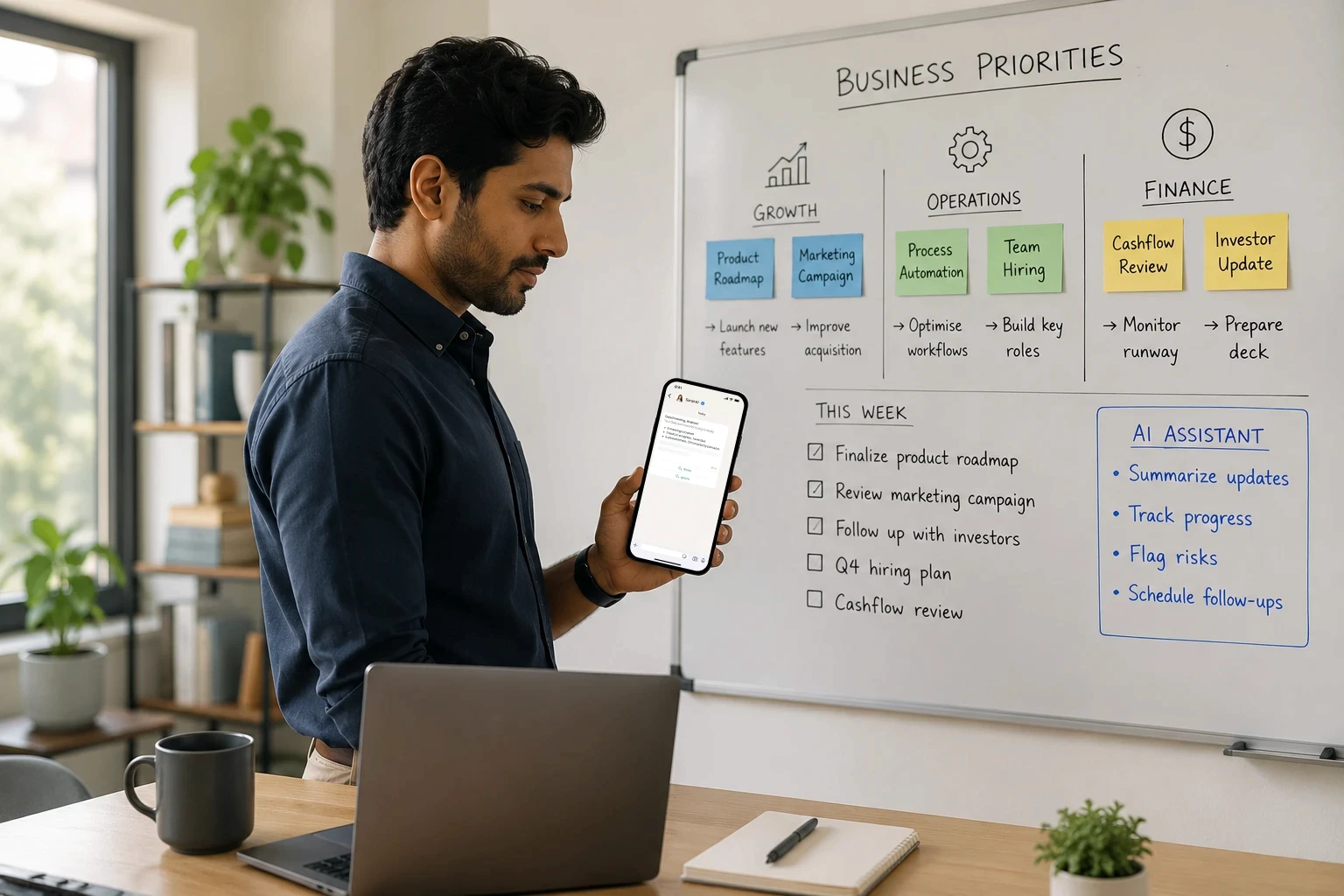
Store platforms run the storefront. Helpdesks run support. Forecasting tools run purchasing. None of them run the day of the person holding it all together.
→ See SarahAI for India: thesarahai.com/sarahai-in
→ Related read: AI Productivity Tools for E-commerce and Retail Businesses
Recommended Stacks by Brand Stage
Early stage - under 500 orders a month
Shopify with Magic - storefront and product content
Canva AI - creative assets without a designer
SarahAI - supplier follow-ups, restock reminders, deadlines ($9.99/user/month)
Skip RTO engines, helpdesks and forecasting platforms at this volume - order counts are still small enough to hold in view, and the implementation load outweighs the return. Do track your RTO rate manually from day one, because you will need the baseline.
Scaling - 500 to 5,000 orders a month
RTO and COD risk engine - this is the single highest-return investment at this stage
WhatsApp-native support automation - support breaks here first
Unified inventory across channels - before, not after, the first oversell incident
Klaviyo or equivalent - lifecycle flows on customers already acquired
SarahAI - founder layer: freight, suppliers, marketplace deadlines, team delegation
This is the band where the working-capital squeeze bites hardest. Fix returns and inventory before adding acquisition spend - growing a leaky unit economic simply loses money faster.
Multi-channel - D2C plus marketplaces plus quick commerce
Unified inventory as the system of record - the single biggest source of avoidable loss in multi-channel Indian retail
Channel-agnostic architecture - assume the mix will change again within eighteen months
Consolidated support inbox across WhatsApp, marketplace messaging and email
SarahAI - for the founder and channel managers: partner meetings, promotion deadlines, supplier negotiations
At this stage integration between systems matters more than the individual capability of each. Prioritise tools that talk to each other over tools with longer feature lists.
What AI Will Not Fix in Indian D2C
Fix the Leak Before Filling the Bucket
India’s D2C market growing from roughly $108 billion toward a projected $322 billion by 2031 is a genuine opportunity. It is also an increasingly crowded one, where competition intensity and copying speed rise alongside the market size.
The founders who compound through that do something unglamorous. They fix the return rate before scaling the ad account. They unify inventory before adding a fourth channel. They automate support before hiring a third support person. Each of those is a cash decision, not a growth decision - and in a market where working-capital stress has spawned an entire financing category, cash decisions are the ones that determine who is still operating in three years.
And underneath every one of those systems sits the part no platform covers: the freight follow-up, the marketplace deadline, the restock decision that needed making yesterday. Automating the storefront while that runs on memory is optimising the visible half of the business.
More from SarahAI
Frequently Asked Questions
What are the best AI tools for D2C brands in India in 2026?
Ordered by financial impact: an RTO and COD risk engine such as GoKwik or Shiprocket Engage, WhatsApp-native support automation, unified inventory and forecasting through Unicommerce or Zoho Inventory, content and lifecycle tools including Shopify Magic, ChatGPT, Canva AI and Klaviyo, and an assistant such as SarahAI for the founder’s own supplier, freight and deadline coordination.
Why do Indian D2C brands struggle with cash flow?
Cash-on-delivery return rates of 25 to 30 percent are the primary driver. Every returned COD order costs forward shipping, return shipping, packaging and tied-up working capital with no revenue against it. This has been significant enough to catalyse revenue-based financing models that extend 15 to 30 percent of monthly sales as short-term liquidity to brands scaling through the problem.
How big is the D2C market in India?
India’s D2C e-commerce market was valued at around $87.5 billion in 2025 and reached approximately $108.76 billion in 2026, with projections of 24.3 percent compound annual growth to $322.1 billion by 2031. Delhi NCR held around 20.55 percent of the market in 2025, while Hyderabad is forecast to be the fastest-growing city node through 2031.
Should Indian D2C founders invest in AI for marketing or operations first?
Operations, in most cases. With return rates at 25 to 30 percent and the majority of working capital sitting in inventory, the cash recovered from reducing returns and improving stock accuracy typically exceeds what an equivalent investment in acquisition optimisation returns. Growing a business with leaky unit economics simply loses money faster.
How does WhatsApp fit into an Indian D2C tech stack?
It is the primary customer channel rather than a supplementary one. More than 80 percent of small and medium businesses in India consider WhatsApp essential for business communication, so support automation that is not WhatsApp-native addresses only part of the volume. It is also where founders coordinate with suppliers, freight partners and their own teams, which is a separate workflow from customer support.
How does SarahAI help D2C and e-commerce founders in India?
SarahAI operates inside WhatsApp as an AI executive assistant for the founder rather than the storefront. It creates supplier follow-ups, restock reminders and marketplace deadlines from voice notes taken during a stock count, schedules logistics and supplier meetings, delegates tasks to warehouse or store staff in their own WhatsApp without new software, summarises unread email with priority alerts, and sends daily and weekly briefs. It supports voice notes in over 100 languages including Indian ones, and costs $9.99 per user per month.
Can AI reduce RTO for cash-on-delivery orders?
Yes, this is one of the clearest applications available. Risk engines score each order using address quality, order history, pin-code performance and behavioural signals, then act on high-risk orders by nudging toward prepaid payment, triggering verification or holding for confirmation. Because every avoided return recovers forward shipping, return shipping and packaging together, the margin impact is usually larger than an equivalent conversion-rate improvement.