How Hospitality and F&B Businesses Can Use AI to Manage Operations
AI Strategy
11 Min
|

Copied


Quick Summary
The Profitability Gap Nobody Mentions on the Floor
In July 2026, Restaurant365 published a mid-year report drawing on responses from more than 420 operators representing nearly 10,000 locations. Its central finding has a name: the Restaurant Profitability Gap- a measurable performance difference between operators using AI to inform operational decisions and those who have not adopted it.
Among operators actively using AI, 61% reported reduced food costs, 62% reported reduced labour costs and 88% reported saving time every week. Nearly a third reported cost reductions of 6% or more- which, on hospitality margins, is the difference between a difficult year and a good one.
Source: Restaurant365- 2026 State of the Restaurant Industry Mid-Year Report, July 2026
The pressure making this matter is not subtle. 83% of operators reported food cost increases in the first half of 2026, and 75% experienced higher labour costs. When input costs rise and menu price increases stop being a viable lever, operational efficiency becomes the only remaining one.
Adoption is accelerating quickly. 62% of operators have now implemented or plan to implement AI in at least one back-office function- more than double the level reported at the beginning of the year, led by reporting and analytics, then scheduling and inventory forecasting.
Source: Restaurant News Resource- AI Users in Restaurant Sector Report Reduced Food and Labor Costs
This guide covers what actually works for independent and small-group operators- restaurants, cafes, QSR, holiday homes and small hotels- organised by operational lane, with realistic costs and honest limits.
62%of AI-using operators report reduced labour costs (Restaurant365, 2026) | 61%report reduced food costs; 88% report saving time every week | 30%reduction in time spent building staff rotas with AI scheduling tools |
Source: Restaurant365 2026 Mid-Year Report; Unlocking Tech restaurant staffing research via Alphacorp

How to Use This Guide
Hospitality operations split into five lanes. Very few independent operators need all five at once, and the sequence matters more than the tool choice- forecasting and rostering deliver measurable results inside a quarter, while guest-facing AI takes longer to show up in the P&L.
Lane 1- Demand forecasting and inventory: predicting covers, ordering accurately, reducing waste
Lane 2- Staff scheduling and labour: rostering against forecast demand rather than guesswork
Lane 3- Guest communication and reservations: bookings, enquiries and no-show reduction
Lane 4- Reviews and reputation: monitoring and responding at the volume modern discovery demands
Lane 5- The owner’s operational layer: supplier follow-ups, renewals, maintenance, staff issues- the running of the business rather than the running of the service
If budget allows only two projects this year, industry research points clearly at demand forecasting and labour scheduling. Both connect to operational data you already have, both produce measurable results inside a quarter, and neither requires a guest to learn anything new.
The Problems AI Solves in Hospitality- With the Data
The Tools- By Lane
Lane 1: Demand Forecasting and Inventory
01 Restaurant365 / MarketManForecasting, inventory and cost control |
What it does These platforms connect POS sales data to inventory and purchasing, then forecast demand to drive order quantities. AI features cover invoice data extraction, recipe costing, variance detection between theoretical and actual food cost, and prep-level forecasting. Restaurant365 sits at the fuller accounting-plus-operations end; MarketMan is lighter and more inventory-focused. |
Key hospitality use case An independent restaurant running 30% food cost with no idea where the variance sits. Connecting POS to inventory surfaces the gap between what should have been used and what actually was- which is usually portioning, waste or shrinkage rather than supplier pricing. This is the highest-value diagnostic most independents have never run. |
Pricing (2026) Both price per location with tiering by module and outlet count. Restaurant365 sits at the higher end and suits multi-site groups; MarketMan is more accessible for single sites. Request current pricing directly. |
Where SarahAI connects the loop The platform tells you the variance. SarahAI makes sure you act on it- "remind me to review the meat supplier pricing with Imran on Tuesday" as a voice note during a stock count, tracked and surfaced in the morning brief. |
Lane 2: Staff Scheduling and Labour
02 7shifts / Homebase / FourthAI-assisted rostering against forecast demand |
What it does Build staff rotas against predicted covers rather than instinct, handle availability and time-off requests, manage shift swaps without a group chat, track labour cost as a percentage of forecast sales in real time, and push schedules straight to staff phones. Fourth and Harri operate at the larger multi-site end; 7shifts and Homebase suit independents and small groups. |
Key hospitality use case A 40-cover restaurant where the manager spends four hours every week building a rota in a spreadsheet and another two handling swap requests over WhatsApp. AI rostering cuts the build time substantially, and the turnover reduction that comes from respecting stated availability is usually worth more than the hours saved. |
Pricing (2026) 7shifts and Homebase both offer free or low-cost entry tiers for a single location, scaling by location and headcount. This is the most accessible high-impact AI purchase in hospitality. |
Where SarahAI connects the loop The rostering platform runs the team schedule. SarahAI runs the owner’s schedule- the supplier meetings, the bank appointment, the licence renewal, the interview- none of which belongs in a staff rota. |
Lane 3: Guest Communication and Reservations
03 SevenRooms / OpenTable / AI voice agentsBookings, enquiries and no-show reduction |
What it does Reservation platforms handle bookings, waitlists, guest profiles and automated confirmation and reminder messaging- the single most effective lever on no-shows. AI voice agents now answer inbound calls during service with high accuracy, taking reservations and answering routine questions without pulling a team member off the floor. |
Key hospitality use case A restaurant losing bookings because the phone rings during service and nobody can answer it. An AI voice agent handles the call, takes the reservation and logs it. Separately, automated confirmation messaging measurably reduces no-shows, which on a full Saturday is the difference between a good night and a mediocre one. |
Pricing (2026) Reservation platforms typically price per location with cover-based or subscription models. AI voice agents are usually priced per call or per month. Costs vary significantly by market- request current rates. |
Where SarahAI connects the loop Guest-facing systems handle the guest. SarahAI handles what the owner promised the guest- the private dining follow-up, the corporate booking quote, the callback about a large party next month. |
Lane 4: Reviews, Reputation and Discovery
04 Review management and AI-optimised listingsBeing found, and being well reviewed |
What it does Review platforms aggregate Google, TripAdvisor and delivery-platform reviews, flag negatives quickly and draft responses. Increasingly important alongside this is structured, accurate listing data- menus, hours, amenities- because AI-driven discovery now parses these directly when answering "where should I eat tonight" style queries. |
Key hospitality use case A venue with four Google reviews from last year and an out-of-date menu across three platforms is functionally invisible to AI-assisted discovery, regardless of how good the food is. Keeping structured data accurate has become a distribution issue, not an admin task. |
Pricing (2026) Entry-level review management tools are inexpensive; some POS and reservation platforms bundle it. Listing accuracy costs nothing but attention. |
Where SarahAI connects the loop SarahAI keeps the maintenance from slipping- a recurring reminder to update seasonal menus across platforms, a task to respond to the week’s reviews, a nudge before a public holiday to update opening hours. |
Lane 5: The Owner’s Operational Layer- The One Nobody Sells You a System For
05 SarahAIAI executive assistant on WhatsApp- for owners and managers |
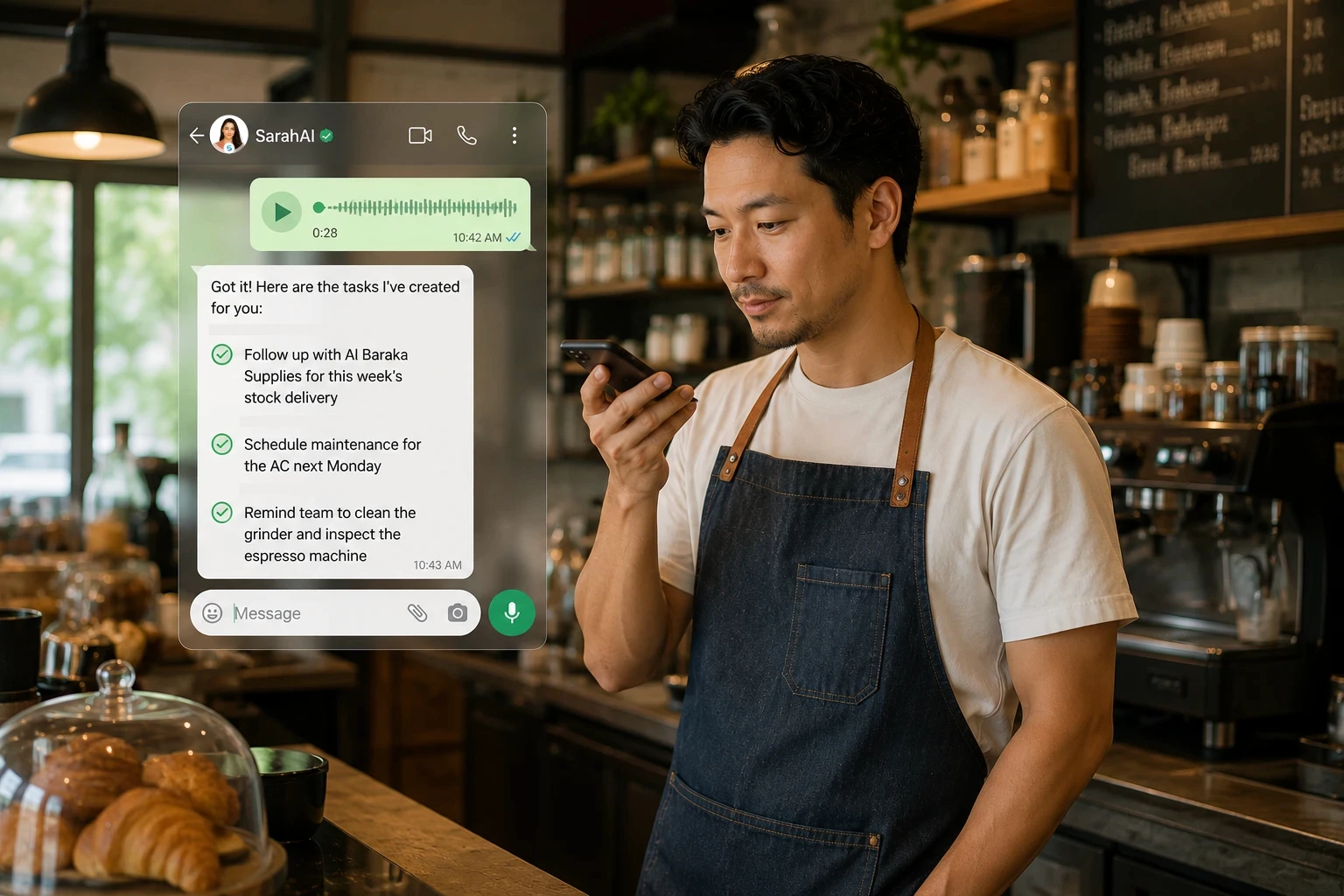
What it does SarahAI is an AI executive assistant that operates natively inside WhatsApp, with a mobile app for configuration and voice. It connects to Google and Outlook for calendar and email, and processes voice notes in over 100 languages- which matters in kitchens where the team speaks several. For hospitality operators it handles the running of the business rather than the running of the service: creating tasks and reminders by voice note between covers, scheduling supplier and maintenance appointments with conflict flagging, delegating to a manager or head chef in their own WhatsApp with no signup, summarising unread email with priority senders surfaced, and sending a daily brief at 8:30am covering the day’s meetings, overdue items and priority messages. |
Key hospitality use case A cafe owner during a Saturday lunch rush. The coffee supplier calls about a delivery change. The landlord messages about the extractor inspection. A staff member asks to swap Thursday. Three voice notes between covers, and all three become tracked items with the right deadlines. On Sunday afternoon the weekly summary shows what closed and what did not- including the extractor inspection that still needs booking before the licence renewal. |
Pricing (2026) AI Assistant: $10/month or $99/year, including calendar, tasks, reminders, delegation, voice notes, email summaries and daily briefs. AI GrowthPro at $25/month adds advanced integrations and team task delegation. 14-day free trial, no credit card required. |
Where it falls short SarahAI is not a rostering system, an inventory platform or a reservation tool. It does not forecast covers, build staff rotas, take bookings or track food cost. It is the owner’s own layer, deliberately sitting alongside those systems rather than attempting to replace them. |
At a Glance: Which Tool for Which Lane
Operational lane | Tool category | Typical payback window | Best for |
|---|---|---|---|
Demand forecasting and inventory | Restaurant365, MarketMan | One quarter | Any venue with food cost above target |
Staff scheduling and labour | 7shifts, Homebase, Fourth | Immediate on rota build time | All shift-based venues |
Reservations and guest comms | SevenRooms, OpenTable, AI voice agents | Immediate on no-shows | Table-service and bookings-led venues |
Reviews and discovery | Review management + structured listings | Ongoing | All venues, especially independents |
Owner’s operational layer | SarahAI | Immediate | Owner-operators and small groups |
Design note for the web build: render as the styled "At a Glance" table used in the India tools blog, with a lane-colour dot beside each row.
The Operator’s Day That Actually Changes
Forecasting and rostering platforms improve the shift. What they do not touch is the running of the business around the shift- the part that happens in fragments, mid-service, and depends entirely on the owner remembering.
→ Related read: How to Manage Tasks From WhatsApp Without Another App
→ Related read: Best AI Scheduling and Calendar Management Tools for Small Business
Recommended AI Stacks by Venue Type
Independent cafe or single-site restaurant
7shifts or Homebase- staff rostering, free or low-cost entry tier
SarahAI- owner layer: supplier meetings, renewals, maintenance, daily brief ($10/month)
Google Business Profile kept current- hours, menu, photos. Free, and increasingly the difference in AI-assisted discovery
Total: around $10–$30/month. Skip full inventory platforms at this scale unless food cost is visibly out of control- the implementation load outweighs the return for a single small site.
Multi-site restaurant group, 3–10 locations
Restaurant365 or equivalent- forecasting, inventory, cost variance across sites
7shifts or Fourth- rostering with labour cost tracking against forecast sales
Reservation platform with automated confirmations- no-show reduction across all sites
SarahAI- for the owner and area manager: site visits, supplier negotiations, compliance deadlines, delegation across venues
This is where the profitability gap bites hardest, because inefficiency multiplies by site. Start with forecasting and rostering- both connect to data you already have.
Holiday homes, small hotels and serviced apartments
Channel manager with AI pricing- dynamic rates across OTAs, one of the fastest-return hospitality AI use cases
Guest messaging automation- check-in instructions, common questions, review requests
SarahAI- housekeeping coordination, maintenance follow-ups, owner reporting reminders, supplier scheduling
For property-based hospitality, pricing and guest messaging deliver the fastest measurable returns. The operational coordination layer is what stops turnover days going wrong.
What AI Will Not Fix
The Gap Is Widening, and It Is Not About Technology
AI adoption in hospitality more than doubled in six months. That means operators evaluating it now are not comparing themselves against last year’s benchmark- they are comparing against a moving and accelerating target.
But the operators pulling ahead did not buy more software. They picked the two use cases with the clearest connection to existing data- forecasting and labour- implemented them properly, and measured the result inside a quarter.
And then most of them hit the same second problem: the systems ran the service well, and the business around the service was still living in the owner’s head. Suppliers, renewals, maintenance, staff conversations, the events enquiry from three weeks ago. No POS covers that. No rostering tool covers it.
That layer is not a technology problem in the usual sense. It is a capture problem- and in hospitality, where the owner is on the floor rather than at a desk, it can only be solved by something that works from a phone, mid-service, by voice.
More from SarahAI
Frequently Asked Questions
How are restaurants using AI to manage operations in 2026?
The most common back-office applications are reporting and analytics, staff scheduling and inventory forecasting. Restaurant365 research covering more than 420 operators found that 62 percent have implemented or plan to implement AI in at least one back-office function, more than double the level reported at the start of 2026. Among operators actively using AI, 61 percent report reduced food costs and 62 percent report reduced labour costs.
Does AI actually reduce restaurant costs?
The published data suggests yes, for operators who implement it properly. Among AI-using operators surveyed by Restaurant365 in 2026, 61 percent reported reduced food costs, 62 percent reported reduced labour costs and 88 percent reported saving time every week, with nearly one-third reporting cost reductions of 6 percent or more. Results depend heavily on data quality- forecasting built on an inaccurate POS setup produces unreliable output.
What is the best AI tool for restaurant staff scheduling?
7shifts and Homebase are the most accessible options for independents and small groups, with free or low-cost entry tiers for a single location. Fourth and Harri operate at the larger multi-site end with deeper demand forecasting. Research on AI scheduling in restaurants reports around a 30 percent reduction in time spent building rotas and a 25 percent drop in staff turnover, largely from matching shifts to demand and stated availability.
Should a single-location cafe invest in AI tools?
Start with staff scheduling, which has genuinely usable free tiers, and keep your Google Business Profile accurate since AI-assisted discovery now parses that data directly. Full inventory and forecasting platforms are usually not worth the implementation load at single-site scale unless food cost is visibly out of control. An assistant for the owner’s own operational load costs around ten dollars a month and requires no team adoption.
What are the main barriers to AI adoption in hospitality?
Restaurant365 research identified the leading barriers as data privacy and security concerns at 37 percent, confidence in output accuracy at 34 percent, implementation cost at 29 percent, and uncertainty about where to begin at 18 percent. Industry analysis adds a practical one: most hospitality AI projects stall on data plumbing rather than model quality, because forecasting requires clean and consistent operational data to work.
How does SarahAI help restaurant and hospitality owners?
SarahAI operates inside WhatsApp as an AI executive assistant for the owner rather than the service. It creates tasks and reminders from voice notes between covers, schedules supplier and maintenance appointments with conflict flagging, delegates to managers and head chefs in their own WhatsApp without requiring new software, summarises unread email, and sends daily and weekly briefs. It works in over 100 languages, which matters in multilingual kitchen teams.
Will AI replace hospitality staff?
The evidence so far points to reallocation rather than replacement in independent and small-group hospitality. AI is being applied to forecasting, rostering, inbound calls and back-office admin rather than to guest-facing service. Industry analysis also finds that venues framing AI as labour replacement encounter staff resistance and poor adoption, while those framing it as removing repetitive work see better results with the same tools.