
AI Agent vs AI Assistant: What Is the Difference?
AI Strategy
12 Min
|

Copied


Quick Summary
Why These Two Words Got Muddled
In 2023 almost everything was called an assistant. By 2025 almost everything was called an agent. Very little about the underlying products changed that fast.
The shift happened because "agent" signals capability and autonomy, which is what buyers and investors reward. So the label migrated ahead of the technology, and now sits on products ranging from a chatbot with a scheduled trigger to genuinely autonomous systems that plan and execute multi-step work across a dozen connected tools.
That matters commercially, not just semantically. Gartner research cited across the agentic AI category found that around 40% of enterprises abandon agentic AI projects, frequently over unforeseen variable costs and in practice, often because what was bought as an autonomous agent turned out to need continuous human supervision.
This piece gives you a way to tell the difference in about two minutes of looking at a product, without taking the vendor’s word for it.
What an AI Assistant Actually Is
An AI assistant acts on your instruction. You say what you want, it does that thing, and it tells you it is done. The unit of work is a request.
That sounds limited until you notice how much of business admin is exactly this shape. "Move Thursday’s call to Friday." "Remind me to send the quote at 5pm." "What is on tomorrow?" None of those need a system to reason about goals. They need something that understands the instruction, asks when a detail is missing, and reliably follows through.
Good assistants add proactivity on top: things that arrive without being asked for, on a schedule or a trigger you set once. A morning brief. An alert before a meeting. A flag when an important email lands. This is often mistaken for agency, and it is worth separating the two clearly, because the distinction is the whole article.
Proactive is not autonomous
A proactive assistant does something you configured, at a moment you did not have to think about. An autonomous agent decides that something should be done, chooses how, and does it.
Concretely: a morning brief arriving at 8:30 with your meetings, overdue tasks and priority emails is proactive. The tool noticing that a supplier has not replied for four days, deciding that matters, drafting a chase and sending it, is agentic.
The first is dependable and cheap. The second is powerful and carries real risk, because when it is wrong it is wrong on your behalf, in front of a customer.

What an AI Agent Actually Is
An AI agent is given a goal rather than an instruction, and works out the steps itself. It can call tools, read results, adjust its plan and keep going until the goal is met or it gets stuck.
Three properties separate a real agent from a well-triggered assistant.
Planning: it decomposes a goal into steps you did not specify
Tool use: it chooses which connected systems to act in, and in what order
Iteration: it reads the outcome of a step and changes what it does next
"Qualify this inbound lead" is an agent-shaped task: check the CRM, enrich the company, score it against criteria, route it or reply. "Create a task to call this lead tomorrow" is assistant-shaped. Same lead, completely different mechanism, and very different failure modes.
Agents earn their cost on repeatable, high-volume processes with clear success criteria. They struggle where the right answer depends on context that is not in any system - which describes most of what a founder actually does in a day.
The Spectrum: Five Positions, Not Two
Placing a product on this spectrum is more useful than arguing about which label it deserves.
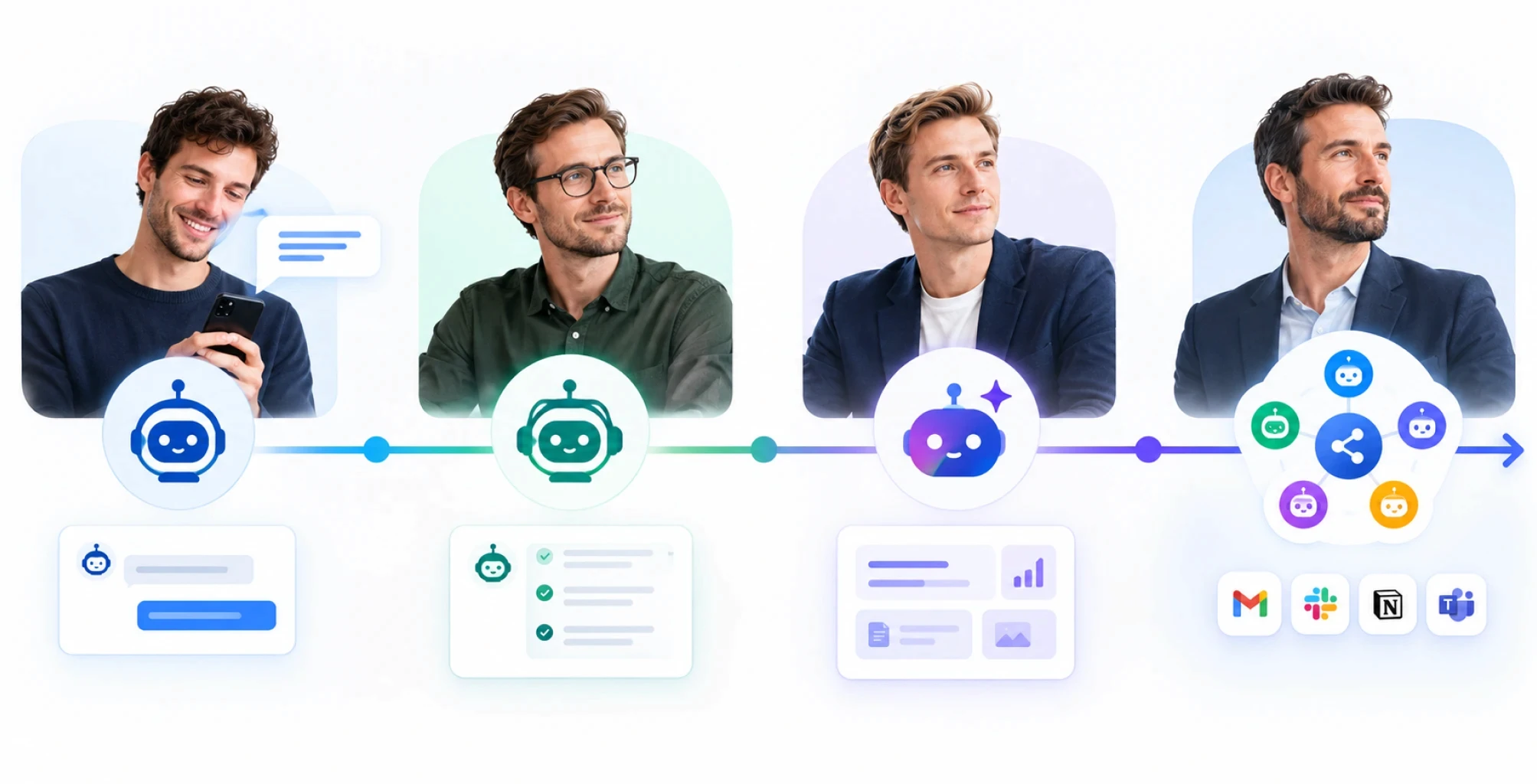
1. ChatbotAnswers questions in a conversation. No memory of your world, no ability to act on anything. Website support widgets, basic FAQ bots. You ask, it answers. Nothing changes anywhere. |
2. AssistantActs on your instruction inside your tools - calendar, tasks, email, messaging. May add proactive behaviours on triggers you configure. This is where most business productivity AI genuinely sits, including SarahAI. You ask, it does the thing, it confirms. |
3. CopilotWorks alongside you inside one application, suggesting and drafting while you remain in control of every output. Code assistants, writing assistants, spreadsheet assistants. It proposes, you accept or reject. |
4. AgentGiven a goal, plans the steps, uses tools, iterates and reports back. Operates across systems with limited supervision. You set an outcome, it figures out how. |
5. Multi-agent systemSeveral specialised agents coordinating, often with one orchestrating the others. Mostly enterprise, mostly early, mostly harder to run than the demos suggest. You set an outcome, a team of agents divides it. |
The Four Axes That Actually Separate Them
Axis | AI Assistant | AI Agent |
|---|---|---|
Who initiates | You do - or a trigger you configured | It does, once given a goal |
Unit of work | A request | An outcome |
Autonomy | Executes the step you named | Chooses the steps itself and adapts |
Scope | Your day and your tools | A process, often across systems and people |
Setup effort | Low - connect accounts, start asking | High - define goals, permissions, guardrails, connections |
Failure mode | It does not understand and asks again | It does the wrong thing confidently, at scale |
Supervision needed | Light - you see each action | Heavy early on - approval gates are standard practice |
Cost model | Usually flat per user | Often metered by task or credit, harder to forecast |
Right when | Work is unpredictable and conversational | Work is repeatable with clear success criteria |
The failure-mode row is the one buyers underweight. An assistant that misunderstands you costs a follow-up message. An agent that misunderstands you can email forty customers before anyone notices.
Where SarahAI Sits - Precisely
Rather than claim a label, here is what the product actually does, mapped against the spectrum above.
01 SarahAIAn AI executive assistant with proactive behaviours, and agent tiers in early access |
The assistant layer - live today SarahAI works inside WhatsApp, with iOS and Android apps for configuration and in-app voice control. You instruct it by typing or by voice note in over 100 languages: create and track tasks, delegate work to someone else’s WhatsApp, schedule, reschedule or cancel meetings, add or remove invitees, check availability, and set one-time or recurring reminders with flexible patterns. On email it summarises unread and priority messages, flags messages from key contacts, and can draft replies and send or forward them once you confirm - nothing goes out without explicit approval. It connects to Google, Microsoft Outlook, Apple iCloud, IMAP and CalDAV, and to Slack for sending, scheduling and managing messages. Notion and Zoho CRM are newly announced. |
The proactive layer - things that happen without you asking This is where SarahAI goes beyond a request-response assistant. A WhatsApp alert ten minutes before every meeting with Reschedule, Move to Tomorrow and Cancel buttons that act differently depending on whether you are the organiser or an attendee. A check-in five minutes after a meeting ends, prompting you to log follow-ups, with back-to-back meetings intelligently grouped into one message. Real-time priority email alerts when something important lands. An intelligent daily brief each morning covering meetings, pending and overdue tasks and priority emails, plus a weekly summary. Overdue tasks surfaced rather than waiting to be found. Each of these is configured once and then arrives on its own. That is proactive behaviour, and it is the reason the product works for people who would never remember to open a dashboard. |
The agent layer - early access tiers AI Growth Pro adds a sales automation agent that logs leads, updates deals and pulls contact history, with smart nudges on deal stage changes and cold leads, weekly pipeline reports, CRM integrations across Zoho, HubSpot and Pipedrive, and outbound calling for task follow-ups and reminders. AI Chief of Staff adds functional agents across finance and accounting, HR and operations, and project management with Asana, Trello, Monday.com and ClickUp. Both tiers are currently in early access and available via demo rather than self-serve signup. |
What it does not do - stated plainly SarahAI does not pursue open-ended goals without instruction, does not join calls, transcribe them or take meeting notes, does not search your mailbox beyond unread and priority messages, does not access files or attachments, and does not create recurring calendar events. On the live tier it is an assistant with proactive behaviours, not an autonomous agent, and describing it otherwise would set the wrong expectation. |
Pricing (2026) AI Executive Assistant: $9.99/user/month, annual billing saves 17%. Unlimited tasks, events and reminders, daily and weekly briefs, email summaries and priority alerts, 2 calendar and 2 email integrations, 100 minutes of voice conversation and 100 business or general questions a month. 14-day free trial, no credit card required. |
Which One Does Your Business Need?
Choose an assistant when
Your work is conversational and unpredictable - client calls, supplier messages, changing priorities
The failure you keep having is forgetting, not slowness
You want value in the first hour, not after a configuration project
Nobody on the team is going to maintain workflow logic
You are the decision-maker and want to stay in the loop on every action
This describes the large majority of SMEs under roughly twenty people.
Choose an agent when
You have a process that runs the same way dozens or hundreds of times
Success is measurable without human judgement - lead qualified, ticket routed, record updated
You can define guardrails and approval points, and someone will maintain them
The volume justifies the setup and the cost of supervision
Lead routing, inbound ticket triage, invoice data extraction and CRM hygiene are genuine agent-shaped problems.
Choose both when
They are not competitors. Agents handle the repeatable machinery; the assistant handles you. A business can run an agent qualifying inbound leads while the founder uses an assistant to make sure the three commitments from this morning’s call actually happen. Different jobs, different failure modes, and no overlap.
How to Test a Vendor’s Claim in One Demo
Five questions that cut through the label.
Ask it to do something you have not configured. Agents handle novelty. Assistants and scripted bots do not.
Ask what happens when a step fails. A real agent retries, adapts or escalates. A rebranded workflow simply stops.
Ask how many steps it takes unsupervised. If the answer is one, it is an assistant regardless of naming.
Ask what it can do that you did not explicitly permit. If the answer is nothing, that is a good safety property - and it also means it is not agentic.
Ask how pricing behaves at ten times the volume. Credit-metered agent platforms change shape at scale, which is where unforeseen costs come from.
The Honest Version of the Agent Story
Buy the Behaviour, Not the Label
The useful question is never "is this an agent or an assistant". It is "what happens on Tuesday at 4:45pm when I agree to three things on a client call".
If the answer you want is that those three things get captured, scheduled and surfaced back to you tomorrow morning without you opening anything, you want an assistant - and you want one that works where you already are, because a tool you have to remember to open has already failed at the job.
If the answer you want is that a lead gets scored, routed and followed up while you are still on the call, that is agent territory, and it is worth the setup.
Most SMEs need the first reliably before the second is worth attempting. Getting the day under control is unglamorous, and it is also the thing that compounds.
More from SarahAI
Frequently Asked Questions
What is the difference between an AI agent and an AI assistant?
An AI assistant acts on your instruction, one request at a time, and tells you when it is done. An AI agent is given a goal rather than an instruction and works out the steps itself, calling tools, reading results and adapting until the goal is met. The practical difference is the unit of work: assistants handle requests, agents handle outcomes.
Is a proactive AI assistant the same as an AI agent?
No, and this is the most common confusion. A proactive assistant performs actions you configured at moments you no longer have to think about - a morning brief, a pre-meeting alert, a priority email notification. An agent decides for itself that something should be done and how to do it. Proactive behaviour is dependable and low-risk; autonomy is powerful and carries real risk when it is wrong.
What is an AI copilot, and how is it different?
A copilot works alongside you inside a single application, suggesting and drafting while you keep control of every output - code assistants, writing assistants, spreadsheet assistants. It sits between an assistant and an agent on the autonomy spectrum: more proactive than a pure assistant, but it proposes rather than acts.
Does my small business need an AI agent or an AI assistant?
Most SMEs under roughly twenty people need an assistant. Their work is conversational and unpredictable, the recurring failure is forgetting rather than slowness, and nobody has capacity to maintain workflow logic. Agents earn their cost on repeatable, high-volume processes with clear success criteria, such as lead routing or ticket triage.
Is SarahAI an AI agent or an AI assistant?
SarahAI’s live product is an AI executive assistant with genuinely proactive behaviours: daily morning briefs and weekly summaries, WhatsApp alerts ten minutes before every meeting with quick action buttons, check-ins after meetings, real-time priority email alerts and surfaced overdue tasks. It acts on your instruction rather than pursuing open-ended goals. Agent-based capabilities - a sales automation agent, plus finance, HR, operations and project management agents - sit in the AI Growth Pro and AI Chief of Staff tiers, currently in early access via demo.
Why do so many AI agent projects fail?
Gartner research cited across the category found that around 40% of enterprises abandon agentic AI projects, frequently over unforeseen variable costs from usage-metered pricing. A second, quieter cause is that many organisations automate a process that was never documented, which produces an automated version of existing inconsistency rather than an improvement.
How can I tell whether a product is really an agent?
Ask it to do something you have not configured, and ask what happens when a step fails. A genuine agent handles novelty and adapts, retries or escalates. Also ask how many steps it takes unsupervised - if the answer is one, it is an assistant regardless of how it is marketed - and how pricing behaves at ten times your expected volume.