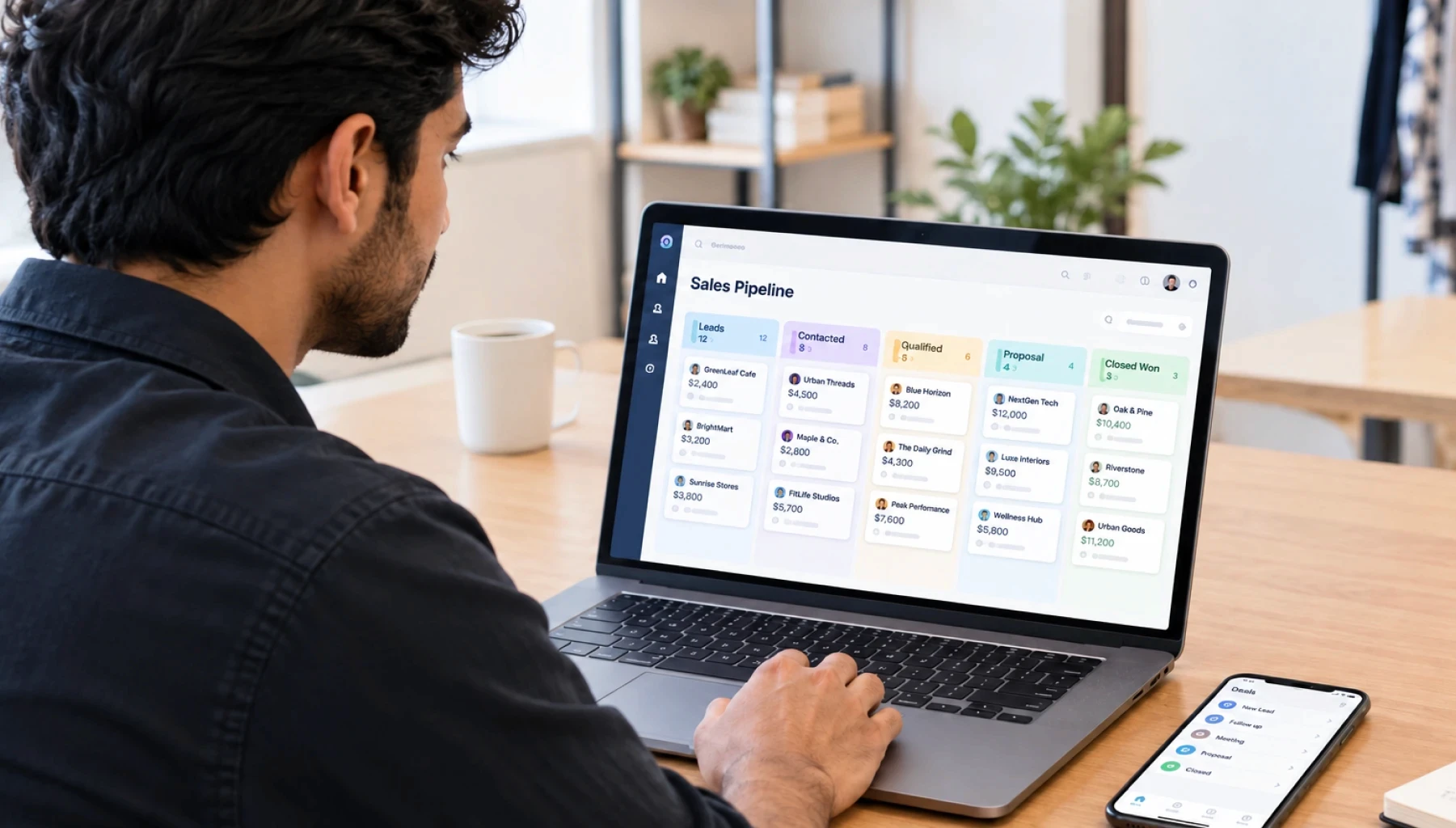
The Case for WhatsApp-First Workflows in Malaysia
Country Spotlight
7 Min
|

Copied


Quick Summary
The Nerve Centre Is Not Where You Think
Walk into any Malaysian SME - a trading company in Petaling Jaya, a creative agency in Bangsar, an F&B brand in Penang, a logistics firm in Johor - and ask the founder where the real work gets done.
They will not point you to a CRM. They will not mention their project management tool. They definitely will not say email.
They will show you their phone. Specifically, they will show you WhatsApp.
Client negotiations. Team briefings. Supplier confirmations. Purchase approvals. Delivery updates. All of it - on WhatsApp. The tool that most Western productivity frameworks treat as an afterthought is, in Malaysia, the operating system of business.
Take Nadia, who runs a 12-person marketing agency in Bangsar. She manages three active client retainers, a team of designers and copywriters, and a roster of freelancers - almost entirely through WhatsApp. "My clients don't want to log into a portal," she says. "They want to WhatsApp me. My team works the same way. It just moves faster."
Nadia is not unusual. She is the rule.
And yet most of the tools sold to SME owners assume they work the way people in San Francisco work; dashboard-first, email-first, desktop-first. That mismatch is not a minor inconvenience. For a founder running operations from a phone, it is a daily tax on time and attention.
This blog is not a guide to WhatsApp features. It is the argument that WhatsApp-first is not a compromise - it is the right strategic foundation for Malaysian SMEs. And that the founders who build proper operations around it, backed by the right AI layer, are the ones pulling ahead.
WhatsApp Is Already Where Malaysian Businesses Live
This is not an opinion. It is the data.
84%of Malaysian internet users are on WhatsApp | 51%of Malaysian SMEs use WhatsApp Business | 98%WhatsApp message open rate vs 20% for email |
WhatsApp reaches the vast majority of Malaysia's internet-using population - making it the dominant messaging platform in the country by a substantial margin. More than half of all registered Malaysian SMEs already use WhatsApp Business for customer interactions, according to Meta's research on Southeast Asia business. And across the region, business account growth rates have been accelerating year on year - driven by exactly the kind of mobile-first, relationship-first market that Malaysia represents.
But statistics only tell part of the story. The deeper truth is cultural. Business in Malaysia has always been relationship-first, conversation-first, and mobile-first. WhatsApp did not reshape how Malaysian founders communicate - it simply became the natural container for how they were already communicating.
Deals get done in WhatsApp threads. Trust gets built over voice notes. A supplier relationship that would take weeks of email back-and-forth gets established in a single WhatsApp conversation. Decisions that would require a formal meeting in a Western business context get made in a group chat before anyone has sat down.
The voice note, in particular, has become a defining feature of how Malaysian founders operate. It is faster than typing. It carries tone and context in a way that a typed message cannot. And it is how real decisions get made and relayed - in real time, from wherever the founder happens to be.
The numbers that stand out: WhatsApp messages achieve an open rate of around 98%, compared to roughly 20% for email. For operational communications - not marketing blasts, but actual task assignments, client confirmations, team updates - that gap is the difference between a message that gets actioned today and one that gets buried until next week.
→ See how SarahAI works natively via WhatsApp: thesarahai.com/#features

What a WhatsApp-First Workflow Actually Means
Most people hear "WhatsApp-first workflow" and think: send more messages. That is not it.
A WhatsApp-first workflow means that WhatsApp is the primary interface through which business operations are initiated, tracked, and resolved. It means the tools you use plug into WhatsApp - not the other way around.
Here is what that looks like across the four areas that consume most of an SME founder's day:
Client Communication
Quotes go out on WhatsApp. Follow-ups are confirmed in the thread. Relationships are built through direct, fast, personal conversation - not through a CRM profile that neither party ever looks at. For Malaysian clients, a WhatsApp message from the founder feels personal and immediate. An email from a no-reply address does not. That distinction matters more than most tools acknowledge.
Team Coordination
Task assignments dropped into group chats. Updates shared as voice notes from the floor. Decisions made and confirmed in threads that everyone can see. No one needs to log into a separate tool to know what is happening. The morning briefing - the one that used to require everyone in a room - becomes a voice note that team members catch when they surface.
Supplier and Vendor Management
Purchase orders, delivery confirmations, pricing negotiations - all in the same channel as everything else, without switching context. Suppliers in Malaysia operate on WhatsApp too. Meeting them there, rather than asking them to adopt a different system, is how you get faster responses and stronger working relationships.
Operations and Admin
Reminders, deadlines, callbacks, approvals - all moving through an interface that is already open, already being watched, already trusted. The founder does not have to remember to check another tool. It surfaces in the same place as everything else.
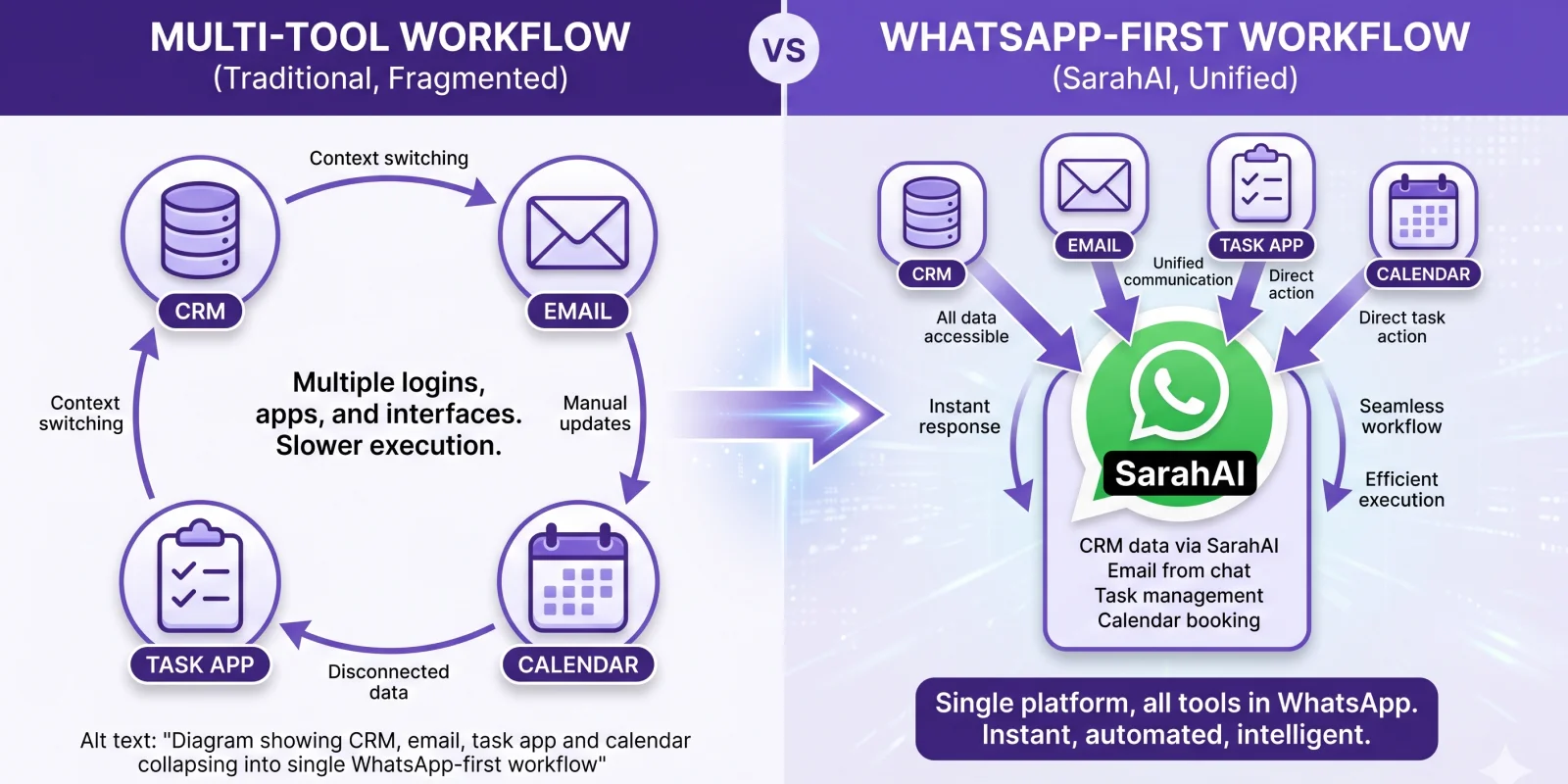
The reason this works is not because WhatsApp is the best possible tool for each function in isolation. It is because consolidating operations into one channel removes the cost of context-switching, app-switching, and attention fragmentation. For a founder managing a business from a phone, that cost is not abstract. It is real time, every single day.
→ Explore SarahAI's task and calendar features: thesarahai.com/#features
Why WhatsApp-First Beats Tool-First Every Time
The standard productivity advice for SMEs goes like this: use the right tool for each job. CRM for clients. Project management for tasks. Email for formal communication. Calendar for scheduling. In theory, reasonable. In practice, for a Malaysian SME founder running operations from a phone while standing on a shop floor or sitting in a Grab, it creates a productivity debt that compounds every single day.
Every tool you add is a tool that needs to be checked. Every platform is an interface that needs to be logged into. Every notification from a separate app is a pull on attention that was already stretched.
There is also the team dimension. When a founder uses five tools and the team uses three of them and clients use one of them, things get lost in translation. Important updates sit in a channel nobody checked. Follow-ups fall through at the seams between systems. The friction is invisible until something slips - and then it costs more to recover than the tool ever saved.
WhatsApp-first solves this not by being the most powerful tool in isolation, but by being the tool that everyone is already on, already watching, and already responding to. That has operational value that most productivity frameworks underestimate.
91%customer satisfaction for WhatsApp-based service queries - beats email & SMS | 80%of SMEs globally use WhatsApp for customer support and communication | 35%fewer no-shows when reminders are sent via WhatsApp vs SMS |
→ Related read: What Busy SMEs in Malaysia Really Need From an Assistant
The Real Gap: WhatsApp Needs Intelligence, Not Just More Messages
Here is the honest part. There is a ceiling to what raw WhatsApp usage can do on its own - and most Malaysian founders have already hit it.
Messages get missed. Voice notes pile up in a thread that is already full. An important follow-up agreed on Tuesday gets buried under group chats by Friday. A deadline discussed in conversation disappears into the scroll. The founder remembers it at 11 pm and scrambles.
WhatsApp-first is the right strategy. The channel is right. The instinct is right. But WhatsApp alone - without structure, without memory, without automation - creates its own version of the chaos it was supposed to solve.
Go back to Nadia, the agency founder in Bangsar. Before she started using SarahAI, she was spending the first hour of every morning scrolling through 15 WhatsApp threads trying to piece together what needed attention that day. "I knew all the information was there," she says. "I just couldn't extract it fast enough. By the time I had figured out my priorities, half the morning was gone."
This is the real gap. Not "should Malaysian SMEs use WhatsApp for business" - they already do. The question is whether WhatsApp is working for them, or whether they are still managing it manually.
In practice, that intelligence layer means:
A voice note sent in WhatsApp becomes a scheduled task with a deadline and a reminder - automatically
A follow-up committed in a client thread is flagged before the deadline - without a separate reminder being set anywhere else
A morning brief lands in WhatsApp at 8:30 am, telling you exactly what needs attention today - without scrolling through 14 groups to work it out
An overdue task gets re-surfaced before it becomes a problem - not after the client has already chased twice
Recurring check-ins, team updates, and follow-up sequences run on autopilot - set once, then done
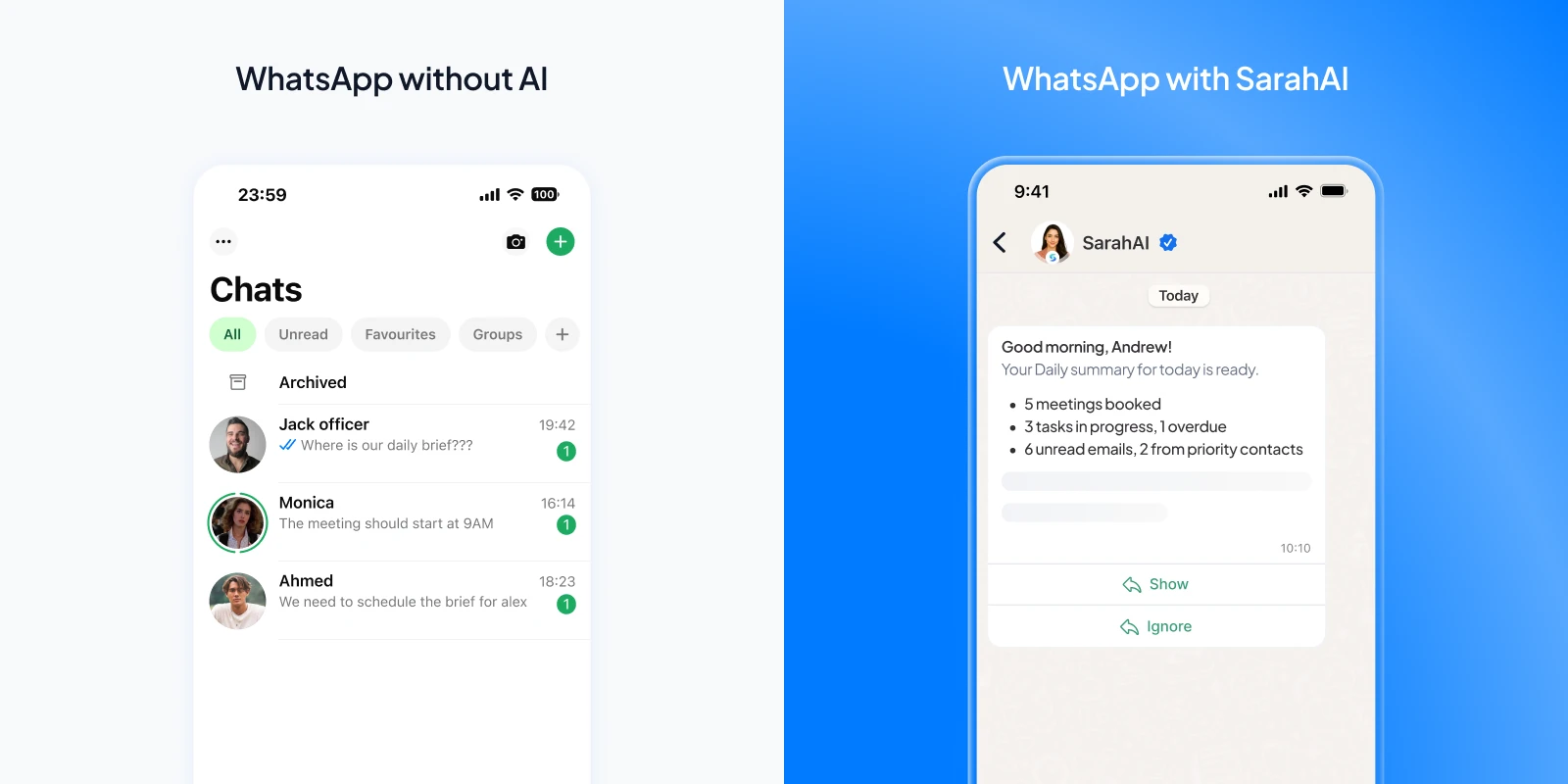
This is what SarahAI was built to be: the intelligence layer inside WhatsApp. Not a replacement for the channel you already trust - but the layer that makes it operational instead of just conversational.
→ See SarahAI’s full feature set: thesarahai.com/#features
A Day in the Life: What the WhatsApp-First Workflow Looks Like
Enough theory. Here is the same working day - with and without the AI intelligence layer.
WhatsApp Without Intelligence | WhatsApp + SarahAI |
|---|---|
7:30 am - Scrolling through 14 WhatsApp threads trying to work out what needs action today. The day starts reactively. | 8:30 am - Morning brief arrives in WhatsApp: 3 priority messages, today's meetings, 2 overdue tasks. The day starts with clarity. |
9:00 am - Client sends a voice note asking for revised specs. You mentally note it and plan to take action on it later. | 9:00 am - You reply via voice note. SarahAI captures the commitment and creates a task with a deadline. It will not be forgotten. |
11:30 am - On the way to a site visit. You need to follow up with a supplier, but have no way to set a reminder without stopping to type it out. | 11:30 am - Quick voice note to SarahAI: "Remind me to chase Amir about the delivery on Thursday." Logged. Done. |
2:00 pm - Team check-in was supposed to happen. Three people did not show. No follow-up mechanism in place. | 2:00 pm - Automated team check-in sent via WhatsApp. SarahAI follows up on non-responses and flags them to you. |
6:30 pm - Still at the office catching up on things that were agreed but never tracked. | 5:00 pm - Done for the day. Weekly summary already waiting in WhatsApp: 4 tasks completed, 1 pending, full visibility. No late-night catching up required. |
The founder in both scenarios is equally capable and equally committed. The difference is not discipline. It is whether the channel they are already using is doing the operational heavy lifting - or whether they are doing it themselves, manually, from memory, at the end of a long day.
What This Means for Singapore SMEs
Malaysia is further along the WhatsApp-first curve - but Singapore is moving in the same direction, and quickly.
WhatsApp Business adoption among Singapore SMEs has been growing consistently, and it is now a standard communication layer for businesses with any customer-facing operation. The founders who were early on email are now experimenting seriously with WhatsApp-first workflows, particularly in professional services, F&B, retail, and logistics.
For Singapore founders, the argument shifts slightly. It is less about cultural fit - email still holds more ground in Singapore than in Malaysia - and more about competitive efficiency. Businesses that communicate faster, respond more reliably, and operate with less internal friction win client relationships and retain staff more effectively.
The intelligence layer matters equally. A WhatsApp-first workflow without structure creates the same ceiling in Singapore as it does in Malaysia. The channel advantage only compounds when operations are actually running through it - not just conversations.
→ See how SarahAI works for teams across Southeast Asia: thesarahai.com/industry/creative-services
The Shift That Is Already Happening
There is a broader change underway in how business operations get done, and Malaysian and Singaporean founders are ahead of the curve on it - whether they know it or not.
The old model: build a system first, then try to get people to use it. The new model: start where people already are, and make that place smarter.
Malaysian SMEs need no convincing that WhatsApp is where business happens. They figured that out years before any productivity consultant started writing about it. What they needed - and what is now available through SarahAI - is the AI layer that makes that channel not just fast and familiar, but genuinely operational.
When Nadia gets her 8:30 am brief and already knows her three priorities before she has had her first coffee. When a voice note from a moving Grab becomes a logged task with a reminder rather than a mental note that dissolves by noon. When the supplier follow-up actually happens on Thursday because SarahAI sent the reminder on Wednesday. When the team check-in runs automatically, the founder does not have to hold the whole thing together by force of memory.
That is not a productivity upgrade. That is what it looks like when a business stops depending on its founder being everywhere at once - and starts running like a system.
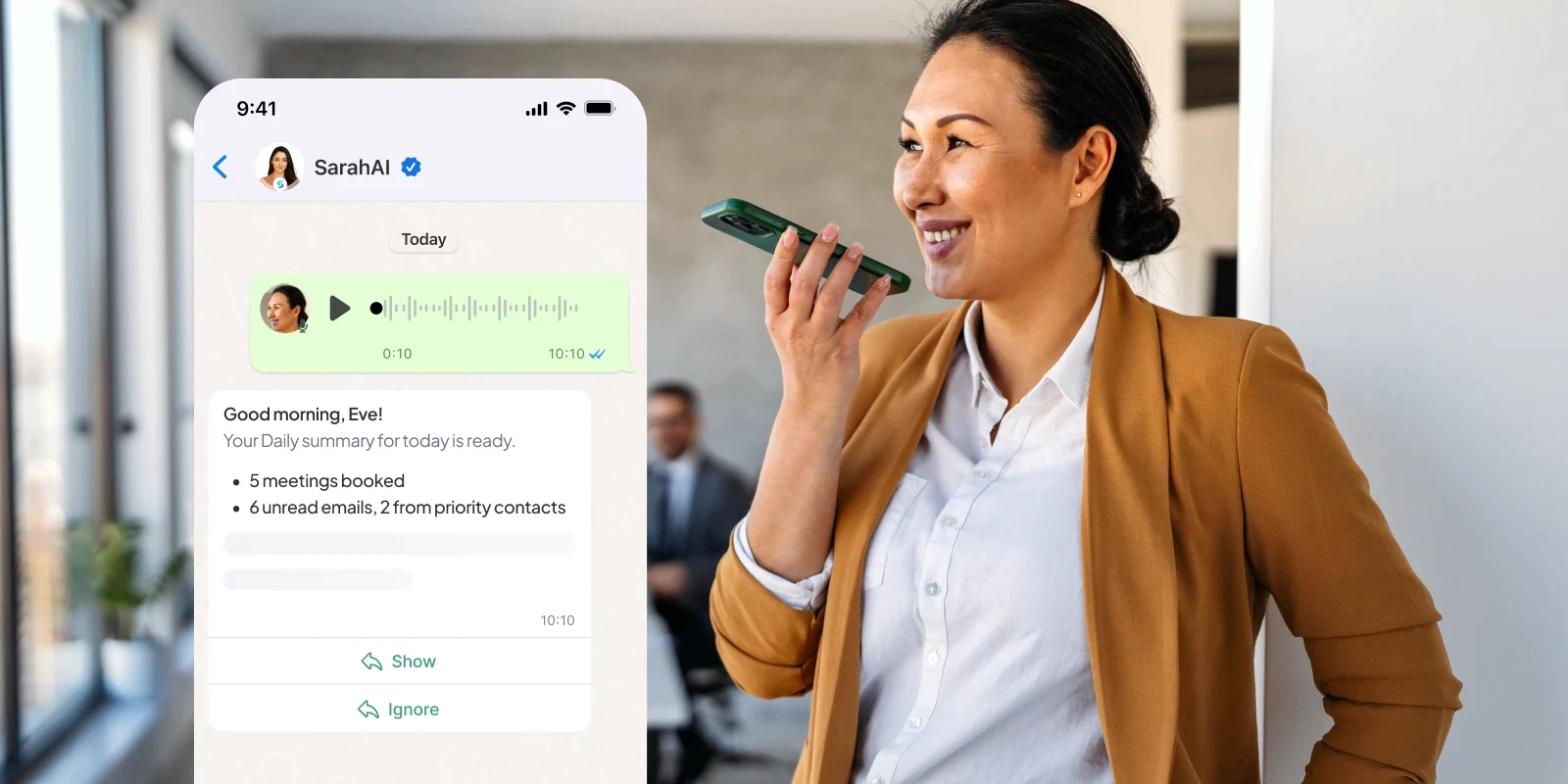
Ready to Make WhatsApp Work Properly for Your Business?
If you are already running your business on WhatsApp - and every Malaysian SME founder is - the next step is not changing the channel. It is making the channel intelligent.
SarahAI is the AI executive assistant that integrates directly with WhatsApp and works through the SarahAI app. It turns your conversations into tracked tasks, your voice notes into scheduled actions, and your morning into something that starts with clarity rather than catch-up.
No new tools to learn. No dashboards to log into. Just the channel you already trust, working the way it always should have.

Explore More from SarahAI
Continue reading from the Malaysia & Singapore SME Series:
Frequently Asked Questions
What is a WhatsApp-first workflow for Malaysian SMEs?
A WhatsApp-first workflow means using WhatsApp as the primary interface for business operations - client communication, team coordination, task tracking, and follow-ups - rather than spreading work across multiple separate tools. For Malaysian SMEs, it matches how business actually happens on the ground.
Why do Malaysian businesses prefer WhatsApp for operations?
WhatsApp dominates mobile communication in Malaysia and is the default channel for business relationships, client conversations, and team coordination across the SME market. It is not an adoption decision founders have to make - it is already the way business gets done. The opportunity is in making it more structured and less reliant on memory.
What is the open rate of WhatsApp messages compared to email?
WhatsApp messages achieve an open rate of around 98%, compared to roughly 20% for email. For operational communications - task confirmations, follow-up reminders, team check-ins - that gap is the difference between a message that gets actioned the same day and one that gets buried. For fast-moving Malaysian SMEs, that is a meaningful operational advantage.
How does SarahAI improve a WhatsApp-first workflow?
SarahAI adds an AI intelligence layer to your existing WhatsApp workflow. Voice notes become structured tasks with reminders. Agreed follow-ups are automatically tracked. Morning briefings with your priorities for the day are delivered via WhatsApp at 8:30 am. The SarahAI app gives you full visibility and control. Nothing falls through the cracks - without you having to hold it all together manually.
Does SarahAI work for Singapore SMEs using WhatsApp?
Yes. SarahAI is built for SME founders across Southeast Asia, including Singapore, where WhatsApp Business adoption among businesses with customer-facing operations is growing steadily. The same workflow intelligence applies - voice notes, task management, daily briefs, and automated follow-ups - all within WhatsApp and the SarahAI app.